

Introduction
Choosing a college is an important decision, but choosing the right area of study is even more important. Every year, thousands of prospective students spend considerable time comparing colleges, tuition fees, campus facilities, financial assistance, and student reviews before deciding. Surprisingly, many of them invest far less time in deciding which profession or career is truly right for them.
The reality is that the area of study you choose will often have a much greater influence on your long-term career success than the name of the institution you attend. A well-chosen field of study can open doors to rewarding careers, continuous professional growth, leadership opportunities, and financial stability. On the other hand, choosing a field that does not match your interests, strengths, or future industry demand may lead to dissatisfaction, frequent job changes, additional retraining, and missed career opportunities.
Before selecting a diploma, take time to understand yourself, explore different career pathways, and seek genuine career guidance. The right decision at this stage can influence not only your first job but also your professional growth for many years to come.
Why This Matters
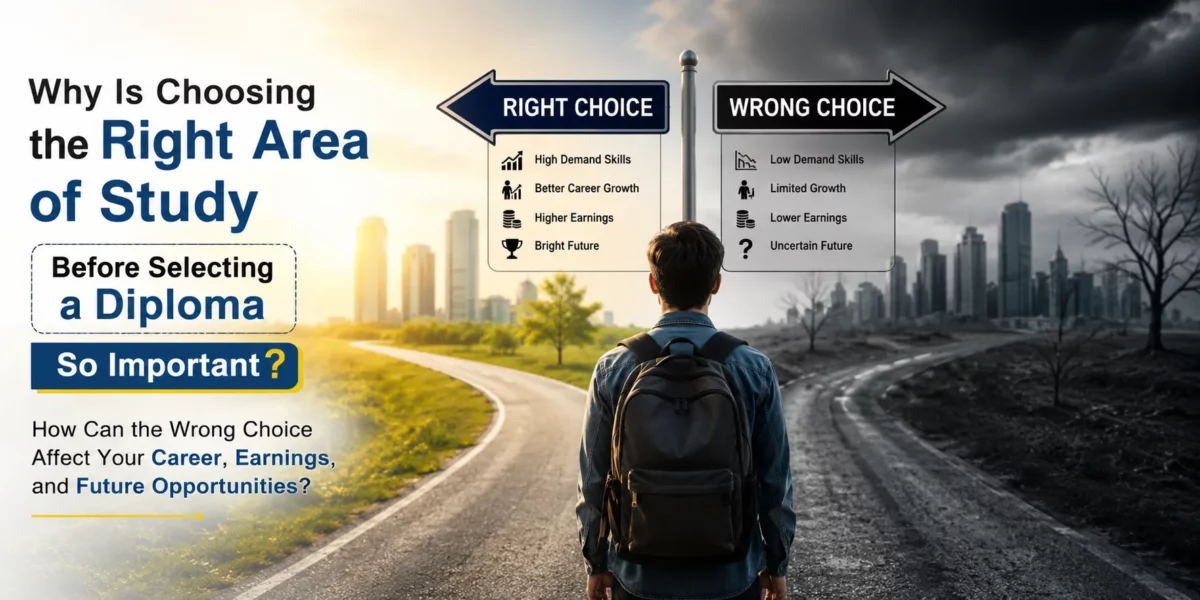
Your choice of study is one of the most significant investments you will ever make-not only financially, but also in terms of your time, energy, and future opportunities. While changing careers is certainly possible, doing so often requires additional education, retraining, and several more years of commitment.
Choosing the wrong area of study can result in:
- Reduced motivation and job satisfaction.
- Difficulty securing employment in your chosen field.
- Lower earning potential over the long term.
- The need to retrain or pursue another qualification.
- Lost time, additional educational expenses, and delayed career progression.
- Missing opportunities in rapidly growing industries.
In contrast, selecting a field that aligns with your interests, strengths, and emerging employer demand can provide decades of professional growth, continuous learning, career advancement, financial stability, and personal satisfaction.
Remember, the diploma is only the beginning. The career you build from that diploma may last 30 or 40 years.
The most important decision is not which college to attend- it is choosing the profession you will enjoy, excel in, and continue developing throughout your career.
Choosing a Diploma Is Not the First Decision
Think in this order: Career → Area of Study → Specialization → Skills → Diploma → College.
Many students begin their educational journey by asking:
- Which college should I attend?
- Which diploma is the most popular?
- Which college offers the lowest tuition?
- Which college is closest to where I live?
While these are important questions, they should not be the starting point.
A more effective approach is to make your decision in the following order:
Career → Area of Study → Specialization → Skills → Diploma → College
1. Choose Your Career
First, decide the profession you want to build over the next 20 to 40 years. Think about your interests, strengths, personality, long-term goals, and the type of work you will enjoy doing every day.
2. Choose the Right Area of Study
Once you have identified your career direction, choose the broader field that supports it, such as Information Technology, Healthcare, Business, Engineering, Hospitality, or another profession.
3. Choose Your Specialization
Most professions offer many different career pathways. For example, Information Technology includes Cloud Computing, Cybersecurity, Artificial Intelligence, Systems Administration, Networking, Healthcare IT, Business Analytics, DevOps, Automation, Data Analytics, Enterprise Systems, and many other specializations. Although these fields are interconnected, they require different interests, strengths, technical skills, and career aspirations.
Choosing the right specialization is one of the most important decisions you will make because it can influence the type of work you perform, the industries you work in, your opportunities for advancement, and your long-term earning potential. A specialization that is ideal for one person may not be the best choice for another.
This is where genuine career counselling becomes invaluable. A career counsellor who has extensive knowledge of current and emerging technologies, understands employer expectations, and appreciates how different technologies complement one another can provide meaningful guidance. Such a counsellor should take the time to understand your interests, strengths, educational background, learning style, and long-term career goals before recommending a specialization.
The best counsellors do not simply recommend the most popular technology or the course with the highest current demand. Instead, they help you identify a specialization that matches your abilities, has strong future growth potential, and provides opportunities for continuous learning and career advancement.
When the leadership of an educational institution has decades of experience in both industry and education, students may benefit from a broader perspective on evolving technologies, workforce trends, and future employer requirements. This experience can help ensure that career advice and curriculum development are aligned with the skills that organizations will need not only today but also in the years ahead.
Remember: The best specialization is not necessarily the one that everyone is choosing; it is the one that best matches your interests, strengths, career aspirations, and future opportunities.
“The diploma is a pathway. The career is the destination. Plan your destination before choosing the pathway.”
The profession you choose today may shape the next 30 or 40 years of your life. Make that decision carefully. Invest as much time in choosing your profession as you would in choosing your home, because both decisions can influence your quality of life for many years.”
4. Develop the Right Skills
Employers recruit people based on their skills and their ability to solve real business problems. Look for programs that provide practical projects, hands-on experience, industry-relevant technologies, and multiple complementary skills that will remain valuable as industries evolve.
5. Select the Diploma
Once you know the career, specialization, and skills you want to acquire, identify the diploma that best prepares you for that pathway.
6. Finally, Choose the College
Only after completing the previous steps should you compare colleges. Consider factors such as curriculum quality, industry relevance, experienced faculty, career guidance, practical learning opportunities, student support, graduate outcomes, and the institution’s commitment to continuously updating its programs to reflect changing employer expectations.
The college is important-but it should support your career decision, not determine it.
What Is an Area of Study?
Examples include IT, Business, Healthcare, Supply Chain, Accounting, Human Resources, Marketing, Hospitality, and Digital Health. Each contains many specializations.
From the Author’s Experience: Success Comes from Enjoying What You Do
One experience within my own family reinforced this lesson very clearly.
A close relative entered the Information Technology profession during the rapid technology growth of the late 1990s. At that time, the demand for qualified IT instructors was so high that I found it difficult to recruit enough trainers for our expanding operations. Seeing this opportunity, he began teaching at several of our training centres while still very young and quickly became one of our most popular instructors because of his enthusiasm, technical ability, and communication skills.
He later joined a leading global technology company, where he worked as a senior technical support professional, assisting customers from many parts of the world. The role was demanding, fast-paced, and technically challenging. Although he was successful, he eventually realized that his long-term passion lay elsewhere.
He made the courageous decision to leave Information Technology and pursue a career in the food industry-a field he genuinely enjoyed. Through hard work, continuous learning, strong leadership, and dedication, he progressed steadily and eventually reached a senior leadership position within that industry. His journey reminded me that true career success comes not from staying in one profession forever, but from finding a profession where your interests, abilities, and motivation allow you to perform at your very best.
Lesson Learned
This experience taught me an important lesson that I have shared with many prospective students over the years.
A successful career is not determined solely by salary, popularity, or employer demand. It is built by finding a profession that matches your interests, strengths, personality, and long-term aspirations. When people genuinely enjoy what they do, they are often more motivated to learn, perform at a higher level, embrace new challenges, and continue growing throughout their careers.
Choose a profession where you can enjoy your work, excel in your responsibilities, and continue developing throughout your professional life. Long-term career satisfaction often comes from the combination of passion, competence, continuous learning, and meaningful contribution-not from salary alone.
Questions to Ask Yourself
- What work will I enjoy?
- Which industries interest me?
- What problems do I enjoy solving?
- Will this field still grow in the future?
- Can I imagine building a lifelong career in it?
Career Self-Assessment
Before choosing an area of study, take a few minutes to reflect honestly on the following questions.
Tick (✓) the statements that best describe you.
Information Technology
- □ I enjoy solving technical problems.
- □ I like understanding how computers, networks, or software work.
- □ I enjoy learning new technologies.
- □ I don’t mind continuously updating my skills.
- □ I enjoy logical thinking.
Business
- □ I enjoy organizing people and projects.
- □ I like planning and decision-making.
- □ I enjoy working with numbers or business reports.
- □ I enjoy communicating with people.
- □ I like solving business problems.
Healthcare
- □ I enjoy helping people.
- □ I am patient and compassionate.
- □ I can remain calm under pressure.
- □ I enjoy learning about health and wellness.
- □ I would like to improve people’s quality of life.
Marketing
- □ I enjoy creativity.
- □ I like social media.
- □ I enjoy writing.
- □ I like understanding customer behaviour.
- □ I enjoy promoting ideas.
Supply Chain & Logistics
- □ I enjoy organizing processes.
- □ I like planning.
- □ I enjoy solving operational problems.
- □ I like working with data.
- □ I enjoy improving efficiency.
Reflection
You do not need to score perfectly. There are no right or wrong answers.
The purpose of this exercise is simply to help you think about which professions naturally match your interests and personality.
Comparison Table
| Area of Study | Typical Careers | Career Growth Outlook |
| Information Technology | Cloud Engineer, Cybersecurity Analyst, Systems Administrator, AI Specialist | Excellent |
| Business | Business Analyst, HR Professional, Office Manager, Operations Manager | Excellent |
| Healthcare | Healthcare Administrator, Healthcare IT, Medical Office Administrator, PSW | Excellent |
| Supply Chain & Logistics | Supply Chain Analyst, Procurement Officer, Logistics Coordinator | Excellent |
| Accounting & Finance | Accountant, Payroll Administrator, Financial Analyst | Excellent |
| Digital Marketing | SEO Specialist, Marketing Coordinator, Content Strategist | Very Good |
| Hospitality & Tourism | Operations Manager, Hotel Manager, Event Coordinator | Good to Excellent |
Engineering Technology | Automation Specialist, Controls Engineer, IoT Engineer | Excellent |
The earlier you make the right decision, the sooner you can begin building the knowledge, experience, confidence, and professional reputation that will benefit you throughout your career.
Should Future Industry Demand Matter?
Yes. Balance your interests with employer demand. AI, Cloud Computing, Cybersecurity, Healthcare IT, Business Analytics, Automation, Digital Health, and Data Analytics continue to grow.
Think Beyond Your First Job
Choose a profession that offers opportunities for leadership, continuous learning, entrepreneurship, international careers, and long-term advancement.
Lessons From Real Career Counselling Experiences
Real-Life Career Story 1: Choosing the Right Direction Can Change Your Future
A few years ago, a prospective student came to me seeking career guidance during one of the most difficult periods of his life.
He had operated his own business for about five years, but unfortunately the business had failed. During our discussion, he said:
“I need a job within six months. If I don’t, I may lose my house, my car, and everything I’ve worked so hard to build.”
Initially, he wanted to pursue a career in ERP. After carefully assessing his situation, communication skills, aptitude, and the demand for different technologies in the job market, I recommended that he specialize in Unix/Linux Systems Administration, while preparing himself to build additional complementary skills as technology evolved.
After only four months of training, he told me that he had already started applying for jobs. I was surprised and asked why he had begun so early.
He replied that he had submitted only five résumés.
I asked, “Didn’t employers call you for interviews?”
He smiled and answered,
“I attended all five interviews.”
At that moment, the experience confirmed something I had observed throughout my career. There were two important reasons for his success. First, there was strong employer demand for those technical skills. Second, his excellent communication skills, confidence, and determination made him a very competitive candidate.
Within the following month, he accepted a position with a major Canadian media organization. At the same time, he continued studying and completed his diploma on a part-time basis.
About seven months later, he came back to collect his diploma. During our conversation, he shared some exciting news-he had accepted a position with Google and was preparing to relocate with his family for the next stage of his career.
Lesson Learned
This experience reinforced something I have believed throughout my career:
The right career guidance is not about recommending the most popular program. It is about understanding the individual, recognizing emerging industry opportunities, and helping the person choose an area of study that matches both their strengths and future employer demand.
Choosing the right specialization at the right time can significantly influence a person’s career, financial stability, and future opportunities.
Real-Life Career Story 2: Building on Existing Experience Can Accelerate Your Career
Another prospective student came to me after working as a Business Analyst. He wanted to move into a more technical career but was unsure which direction would best complement his existing experience.
Rather than recommending a completely different field, I suggested that he choose an IT specialization that would build on his business analysis skills. My advice was based on a simple principle:
The shortest path to career success is often to build upon the knowledge and experience you already have rather than starting all over again.
He followed the guidance and enrolled in the recommended program.
Approximately 11 months after beginning his studies, he secured a contract position with IBM. Shortly afterwards, he was offered another contract opportunity at CIBC, where he had previously worked.
Instead of choosing one opportunity over the other, he made a bold decision.
For approximately six months, he successfully managed both contracts simultaneously-working during the day for one organization and at night for the other.
It was certainly demanding, but his determination, positive attitude, and confidence enabled him to succeed. More importantly, the additional income helped him overcome his financial challenges and rebuild his career.
After completing both contracts, he accepted a full-time position with CIBC, continuing the career growth he had worked so hard to achieve.
Lesson Learned
This experience reinforced another important principle:
Career success is not always about changing direction completely. Sometimes the greatest opportunities come from combining your existing experience with new, in-demand technical skills.
It also demonstrated that confidence, determination, continuous learning, and a positive mindset can open doors that many people initially believe are beyond their reach.
Real-Life Career Story 3: Success Sometimes Requires Patience and Persistence
A prospective student once came to me seeking advice about entering the IT industry. His plan was to study Software Quality Assurance (QA) because he believed it would quickly lead to a permanent career.
After discussing his long-term career goals, strengths, and the industry demand at that time, I recommended a different pathway. I believed that Unix/Linux Systems Administration would provide broader long-term career opportunities and a stronger foundation for continuous growth as new technologies emerged.
He trusted the advice and enrolled in the program.
After successfully completing his studies, he began applying for positions. Like many new graduates, he did not receive a job offer immediately. Rather than becoming discouraged, he decided to continue gaining practical experience by volunteering at CCHS while continuing his job search.
Approximately six months later, he secured a position with a well-known Canadian insurance company.
From that point onward, his career progressed steadily.
Some time later, I happened to meet a former colleague who worked at the same organization. During our conversation, he spoke very highly of this graduate’s technical abilities, professionalism, and contribution to the company.
Years later, I learned that the same graduate had progressed through the organization and eventually became the Director of Information Technology.
Lesson Learned
This experience reinforced an important lesson that I often share with prospective students:
Choosing the right career path is only the beginning. Success also requires patience, persistence, practical experience, continuous learning, and a positive attitude.
Not every graduate secures a position immediately after completing a program. However, those who continue improving their skills, remain committed to their goals, and gain practical experience often achieve remarkable long-term success.
Real-Life Career Story 4: Continuous Learning Opens New Opportunities
Several years ago, an international student came to me seeking career advice. Like many newcomers to Canada, he was struggling to secure employment in his chosen field and was concerned about his long-term future and his pathway toward permanent residence.
After discussing his background, strengths, and career goals, I recommended that he strengthen his practical technical skills by completing several short industry-focused courses. Over the following six months, he worked diligently, developed confidence in the new technologies, and significantly improved his technical abilities.
Not long afterwards, I learned that he had secured an excellent position in Canada and successfully established his career. Over the years, he continued learning, expanding his knowledge beyond the technologies we had originally discussed.
Several years later, I noticed that he had become highly skilled in automation technologies. Recognizing the rapid growth of areas such as DevOps, Infrastructure as Code, Terraform, CI/CD pipelines, and cloud automation, I invited him to return and share his expertise by teaching some of these emerging technologies.
Unfortunately for us-but fortunately for him-he had recently accepted an excellent contract opportunity in the United States. His career had progressed to the point where his professional commitments no longer allowed him the time to teach.
Lesson Learned
Continuous learning does not end after securing your first job. The professionals who continue developing new skills often become the ones sought after by employers around the world. Building expertise in emerging technologies can create opportunities that extend far beyond your first position-and sometimes even beyond your home country.
From the Author’s Experience
Throughout my career, I have seen technology trends rise, mature, and evolve. During the late 1990s and early 2000s, many newcomers to IT chose Windows Systems Administration because it was one of the fastest-growing career paths. The demand was high, partly because organizations around the world were preparing their computer systems for the Year 2000 (Y2K) transition. As more professionals entered the field, competition increased significantly, and the market became much more competitive for entry-level positions.
A few years later, many professionals shifted their attention to Networking, particularly technologies associated with Cisco certifications. Once again, demand grew rapidly, followed by a large increase in the number of qualified professionals entering the market.
Rather than following the crowd, I decided to specialize in Unix Systems Administration, an area that fewer professionals were pursuing at the time. Later, I expanded into SAP NetWeaver Administration and enterprise technologies. These decisions opened opportunities to work with large organizations and enterprise environments while continuing to develop expertise in technologies that complemented one another.
Today, Linux has become one of the most important operating systems in the world. It powers cloud computing platforms, web servers, enterprise applications, supercomputers, container technologies such as Docker and Kubernetes, Artificial Intelligence environments, and many of the world’s largest data centres. The technologies may have changed, but one lesson has remained constant.
Throughout my career, I have learned that the most successful professionals are not necessarily those who chase every technology trend. They are the ones who understand how technologies evolve, continuously upgrade their skills, and make thoughtful career decisions based on future opportunities rather than short-term popularity. A knowledgeable career counsellor who understands these trends can help students avoid oversaturated pathways and identify emerging areas with strong long-term potential.
Lesson Learned
Don’t simply follow the technology that everyone else is learning today. Understand where the industry is heading, evaluate employer demand, consider the level of competition, and build complementary skills that will remain valuable as technology continues to evolve.
“Which career should I choose?”
One lesson has become increasingly clear. Many prospective students spend more time comparing colleges, tuition fees, and program durations than understanding whether they have selected the right profession in the first place.
Throughout my career, I have seen students transform their lives-not because they chose the easiest program or the most popular technology, but because they selected an area of study that genuinely matched their interests, strengths, previous experience, personality, and long-term career aspirations.
I have also learned that career success is rarely determined by technical skills alone. Communication skills, a positive attitude, perseverance, continuous learning, and the willingness to embrace change often distinguish outstanding professionals from the rest.
Another lesson I have seen repeatedly is that career changers do not always need to start from the beginning. In many cases, combining existing professional experience with new, future-ready technical skills creates opportunities that neither skill set could provide on its own.
Lesson Learned
Choosing the right area of study before selecting a diploma is one of the most important decisions you will ever make. The right choice, combined with genuine career guidance, continuous learning, and perseverance, can influence your career, financial stability, personal confidence, and quality of life for decades.
Perhaps the most rewarding part of my career has been seeing former students return years later-not simply to share news of promotions or successful careers, but to say that choosing the right direction at the beginning changed the course of their lives.
Career Perspective
Receiving genuine career guidance before investing in your education can save years of frustration, reduce the risk of selecting the wrong profession, and help you build a career that continues to grow throughout your working life.
Why Students Choose the Wrong Area
Friends, parents, popularity, salary alone, social media, or short-term financial considerations often influence decisions more than personal interests and strengths.
The Bottom Line
“Don’t choose your diploma first. Choose your future first.”
The decisions you make before enrolling can influence the opportunities available to you long after graduation. Choose wisely.
The right area of study can influence your career opportunities, earning potential, job satisfaction, leadership opportunities, and quality of life for decades. Invest time in understanding yourself, researching different professions, and seeking genuine career guidance before making one of the most important decisions of your life.
Need Career Guidance?
If you are still uncertain about which profession or area of study best matches your interests, strengths, previous experience, and long-term career goals, seek genuine career guidance from an experienced professional before investing your time, effort, and money in your education. A thoughtful discussion today can help you avoid costly mistakes and build a career that continues to grow for decades.
Before choosing an area of study, you may also wish to read our article “Who Is Qualified to Provide Genuine Career Counselling for IT, Business, and Healthcare Programs?”
If you are considering Information Technology, read “I’m Finding It Difficult to Choose the Right IT Career. What Factors Should I Consider? Can I Get Free Expert Guidance?”
Before You Decide
Ask yourself three reflective questions:
Am I choosing a profession that genuinely interests me?
Will this field continue to create opportunities over the next decade?
Have I sought genuine career guidance before making this important decision?
A career is one of the few investments that can continue generating returns throughout your lifetime. Choosing it wisely is one of the most important decisions you will ever make.
About the Author
The author has more than four decades of experience in education, business, human resources, corporate training, Information Technology, enterprise systems, cloud computing, cybersecurity, automation, and Artificial Intelligence. Having transitioned from a Bio Science background into IT in 1985, he is passionate about helping students and professionals make informed career decisions and prepare for the technologies, skills, and careers of the future.
Frequently Asked Questions
No. Your first decision should be which profession or career you want to build, not which college you want to attend. Once you have identified your career direction, select the area of study, specialization, skills, diploma, and finally the college that can best prepare you for your chosen profession. The college should support your career decision-not determine it.
Both are important, but choosing the right profession and area of study should come first. Even an excellent college cannot change the fact that a student selected a field that does not match their interests, strengths, or long-term career aspirations. A well-chosen profession provides the foundation for lifelong career satisfaction and growth.
In many cases, yes. Genuine career counselling helps students understand their interests, strengths, personality, career goals, and future industry trends before selecting a program. It can reduce the likelihood of choosing an unsuitable career, changing professions later, or spending additional time and money on retraining.
Yes. Technology is transforming almost every profession. When selecting an area of study, consider not only today’s job market but also how Artificial Intelligence, automation, cloud computing, digital transformation, and other emerging technologies are likely to influence your profession over the next five to ten years.
Absolutely. Many successful professionals change careers during their working lives. However, making an informed decision at the beginning can save considerable time, money, and effort. Continuous learning allows professionals to adapt as industries and technologies evolve.
No. People successfully change careers at many different stages of life. What matters most is your willingness to learn, develop new skills, and adapt to changing industry requirements. Your previous education or work experience can often become an advantage in your new profession.
Ideally, consider both. A career that matches your interests is more likely to keep you motivated and encourage continuous learning. At the same time, understanding employer demand, career growth, earning potential, and future opportunities will help you make a balanced and informed decision.
Yes. Artificial Intelligence is transforming how work is performed across almost every industry, including Information Technology, Healthcare, Business, Finance, Human Resources, Supply Chain, Marketing, Engineering, and Education. Understanding how AI is being integrated into your chosen profession can help you identify valuable specializations and future-ready skills that will improve your long-term career prospects.
That is quite common. Many students have interests in several professions. A knowledgeable career counsellor can help you compare different career pathways, understand the advantages and challenges of each, and identify the area that best aligns with your interests, strengths, and long-term goals.
Research current employer demand, labour market trends, technological developments, and future workforce requirements. Speak with experienced professionals and career counsellors who understand how industries are evolving. Choosing a profession with strong long-term growth potential can provide greater career stability and opportunities for advancement.
Definitely. Employers increasingly seek professionals who possess multiple complementary skills rather than expertise in only one area. For example, combining Cloud Computing with Cybersecurity, Artificial Intelligence with Data Analytics, or Business Knowledge with Information Technology can improve employability, increase leadership opportunities, and enhance long-term career growth.
Yes. A good diploma should prepare you not only for your first job but also for future career progression. Consider whether the program develops problem-solving abilities, communication skills, leadership potential, business awareness, and multiple complementary technical skills that can help you advance into senior technical, management, or executive roles as your career develops.
Not necessarily. While popular professions may offer many opportunities, they can also attract large numbers of applicants, increasing competition for entry-level positions. It is often wise to consider emerging specializations with strong employer demand and relatively fewer qualified professionals. The best career choice is one that balances your interests, strengths, future industry demand, and long-term opportunities for growth.
Latest Post
- What Is Agentic AI? Skills, Careers & Future Job Opportunities
- Best Courses to Get a Job in Canada After Graduation
- AI, IoT and Edge Computing: How These Technologies Work Together
- AI-Powered Cyber Attacks: What Students & Businesses Must Know
- What Is Healthcare Administration and Is It Good in Canada?