

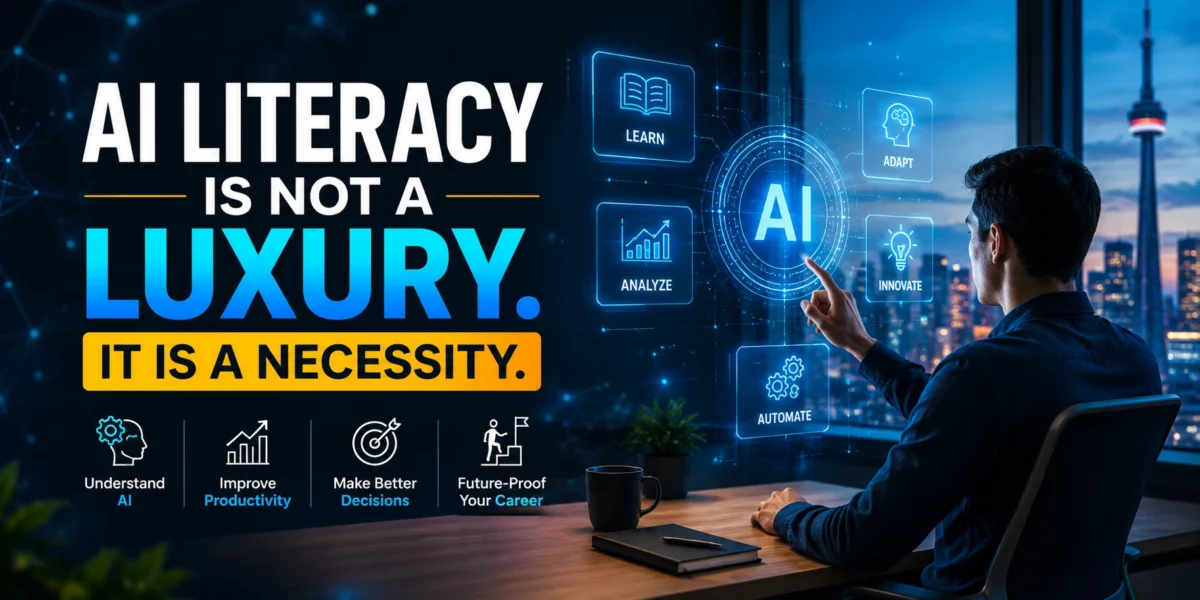
A Lesson From 1985 That Still Applies Today
In 1985, I taught Computer Literacy.
At the time, many people believed computers were only for programmers, scientists, and large corporations. Many professionals saw computers as an optional skill that had little relevance to their careers. Most business owners assumed that computers belonged in research labs and universities, not in everyday offices, retail stores, or service industries. The idea that a manager, an accountant, or a healthcare worker would one day rely on a computer every single day seemed distant, even unnecessary, to many people at that time.
To encourage people to learn, one of my flyers carried a simple message:
“Computer Literacy Is Not a Luxury. It Is a Necessity.”
Another flyer stated:
“If You Don’t Learn the Right Computer Skills Now, a New Generation Will Push You into Illiteracy.”
Some people thought those statements were too strong.
Others believed computers would never become important in their profession.
History proved otherwise.
Today, computer literacy is expected in virtually every profession. It is no longer a specialized skill reserved for a small group of technical experts. It has become a baseline expectation, much like reading or basic math, that every working professional is assumed to have.
Whether you are a healthcare worker, accountant, office administrator, manager, marketer, logistics professional, entrepreneur, business owner, or executive, computer skills are no longer optional.
They are essential.
Today, we are witnessing a similar transformation.
The difference is that this time the technology is Artificial Intelligence. And just as the shift toward computer literacy took time to be accepted by the broader workforce, the shift toward AI literacy is following a familiar pattern of early skepticism, gradual adoption, and eventual necessity.
AI Literacy Is the New Computer Literacy
Many professionals still believe AI is only relevant to:
- Programmers
- Data Scientists
- Technology Companies
This is remarkably similar to how many people viewed computers in the 1980s. Back then, it was common to hear that computers were a passing trend, or that they were only useful for a narrow set of technical roles. The same kind of thinking is now surfacing around Artificial Intelligence, even though the evidence increasingly points in the opposite direction.
Today, Artificial Intelligence is rapidly becoming part of:
- Healthcare
- Accounting and Finance
- Human Resources
- Supply Chain and Logistics
- Marketing and Sales
- Business Administration
- Customer Service
- Manufacturing
- Education
- Government Services
Each of these sectors is already experimenting with AI-powered tools in some form, whether it is used for scheduling, forecasting, communication, reporting, or decision-making. The reach of AI is not limited to a single department or a single type of company. It is spreading across industries in a way that mirrors how computers spread across every type of workplace decades ago.
The question is no longer whether AI will affect your profession.
The question is whether you will understand how to use it effectively.
Canada’s AI Economy Is Growing
Canada’s recent announcement of approximately $2 billion in Artificial Intelligence investment and the projected creation of approximately 250,000 AI-related jobs demonstrates where the economy is heading. This is not a small or symbolic gesture. It reflects a broader recognition that AI is becoming a foundational part of how the Canadian economy will function in the years ahead.
The demand is not only for AI engineers and programmers.
Organizations increasingly need:
- Business professionals who understand AI
- Healthcare professionals who understand digital health technologies
- Supply chain professionals who can use analytics and forecasting tools
- Accountants who can leverage AI-powered productivity tools
- Managers who can lead AI-enabled workplaces
- Administrators who can work effectively with intelligent business systems
This wide range of roles shows that AI adoption is not confined to technical departments. It is becoming embedded into everyday business operations, from the front desk to the executive boardroom.
AI is becoming a workplace skill, not just a technical skill. Just as knowing how to use a spreadsheet or send a professional email became a basic expectation in offices, understanding how to work alongside AI tools is quickly becoming part of what it means to be job-ready.
The New Workplace Divide
In the coming years, the workplace may not be divided between technical and non-technical professionals.
It may be divided between: People Who Understand AI and People Who Do Not
This is a meaningful shift in how we think about workplace skills. In the past, the divide was often about which department you worked in, or whether your job required coding knowledge. Going forward, the more important divide may simply be whether a person has taken the time to understand how AI works and how it can be applied to their daily responsibilities.
The professionals who understand AI will often be able to:
- Work more productively
- Analyze information more effectively
- Make better decisions
- Adapt more quickly to change
- Improve customer service
- Create greater value for employers and clients
These advantages compound over time. A professional who learns to use AI tools early is likely to build habits and workflows that continue to pay off as the technology matures and becomes even more integrated into daily business processes.
Those who ignore AI may find it increasingly difficult to remain competitive in a technology-enabled workplace. This is not meant as a warning to create fear, but as an honest reflection of how quickly workplace expectations can shift once a new technology becomes mainstream.
The Biggest Risk Is Not AI
Many people worry that AI will replace jobs.
History suggests a different lesson.
When computers became mainstream, they did not eliminate the need for professionals.
Instead, they transformed professions. Roles that once involved manual paperwork, physical filing systems, and slow communication methods evolved into roles that used digital tools to work faster and more accurately. The professionals themselves were not replaced; their day-to-day responsibilities simply changed.
The people who learned computer skills advanced.
The people who refused to adapt often struggled.
The same principle applies today.
The biggest risk is not that AI will replace you.
The biggest risk is that someone who knows how to use AI effectively may become more productive, more valuable, and more competitive than someone who does not. In other words, the risk is not the technology itself, but the gap that forms between those who adopt it early and those who wait too long.
AI Literacy Does Not Mean Learning Programming
Just as computer literacy did not require everyone to become a software developer, AI literacy does not require everyone to become an AI engineer. This is an important distinction, because many professionals hesitate to explore AI simply because they assume it requires advanced technical training.
AI literacy means understanding:
- What AI can do
- What AI cannot do
- How AI affects your industry
- How to use AI responsibly
- How to improve productivity using AI tools
- How to make better decisions using AI and analytics
- How to combine human expertise with intelligent technologies
These skills are becoming valuable in virtually every profession. A healthcare administrator does not need to build an AI model to benefit from AI-powered scheduling tools. An accountant does not need to write code to benefit from AI-assisted reporting software. What matters most is developing a working understanding of these tools and knowing how to apply them responsibly within a specific professional context.
Preparing for the Future
Whether you are:
- A student planning your career
- A working professional looking to stay relevant
- A career changer seeking new opportunities
- A business owner exploring AI adoption
- An employer preparing your workforce
Developing AI literacy may be one of the most important investments you make in your future. It is not simply about keeping up with a trend. It is about building a foundation of skills that will remain relevant as workplaces continue to evolve around intelligent technologies.
How Canadian College for Higher Studies Can Help
Canadian College for Higher Studies (CCHS) helps individuals and organizations prepare for Canada’s emerging AI economy through a range of structured learning pathways designed for different needs and schedules.
Diploma Programs
- Prompt Engineering and GenAI for Office Professionals
- Medical & Health Office Administration
- Graphic Design, Web Design & Digital Marketing (AI-driven)
- Business Administration (with data driven decision making)
- International Business Management
- Supply Chain & Logistics Management
- Computerized Accounting & Office Administration
- Cloud-Based IT Support & Cybersecurity
- Diploma in Cybersecurity & AI-Driven Threat Detection
- Cloud Data Analytics & Edge AI Security
One-Day Workshops
- Artificial Intelligence for Business Professionals
- AI Productivity and Automation
- AI for Accounting and Payroll Professionals
- AI for Healthcare Administration
- AI for Supply Chain and Logistics Professionals
- Business Forecasting and Analytics
- Data Analytics for Managers
- Digital Transformation Fundamentals
Micro-Skills Training
Focused programs designed to help professionals quickly develop practical AI, analytics, productivity, and digital transformation skills. These shorter, targeted sessions are designed for professionals who want practical, applicable knowledge without committing to a full diploma program.
Funding Opportunities May Be Available
For Individuals
Eligible individuals may wish to explore:
- Better Jobs Ontario (BJO)
- Career Transition Programs
- Workforce Development Initiatives
For Employers
Organizations may wish to explore:
- Ontario Job Grant (OJG)
- Employer Training Programs
- Workforce Development Funding Opportunities
Eligible employers may be able to receive support for approved employee training, workshops, diploma programs, and workforce development initiatives. These funding pathways are designed to reduce the financial barrier for both individuals seeking new skills and organizations aiming to upskill their existing workforce.
A Message From 1985 That Still Applies Today
Forty years ago, I told people:
“Computer Literacy Is Not a Luxury. It Is a Necessity.”
Today, I believe the message has evolved.
“AI Literacy Is Not a Luxury. It Is a Necessity.”
And just as computers transformed the workplace, Artificial Intelligence is transforming the future of work.
The question is not whether AI will become important.
The question is whether you will be ready when it does.
About the Author
Donatus Doss
President, Canadian College for Higher Studies (CCHS)
Donatus Doss has spent more than four decades helping individuals and organizations prepare for technological change. Long before computers became a standard workplace tool, he promoted the message:
“Computer Literacy Is Not a Luxury. It Is a Necessity.”
Today, he believes the same principle applies to Artificial Intelligence and workforce development. Through education, workforce training, diploma programs, and corporate learning initiatives, he continues to help students, professionals, employers, and career changers prepare for Canada’s emerging AI economy.
Frequently Asked Questions
Because history is repeating itself. In 1985, computers were seen as optional, just as AI is often viewed today. Computer skills eventually became essential across all professions, and AI literacy is following the same trajectory now.
No. AI literacy focuses on understanding what AI can and cannot do, how it applies to your industry, and how to use it responsibly. Just as computer literacy did not require coding, AI literacy does not require becoming an engineer.
Healthcare, accounting, human resources, supply chain, marketing, business administration, customer service, manufacturing, education, and government services are all mentioned as sectors where AI is becoming increasingly relevant.
CCHS offers diploma programs like Cybersecurity with Artificial Intelligence, one-day workshops such as AI for Business Professionals, and micro-skills training focused on practical AI, analytics, and productivity skills for working professionals.
Yes, eligible individuals may explore Better Jobs Ontario and Career Transition Programs, while employers may explore the Ontario Job Grant and other workforce development funding opportunities to support employee training.
The article states the biggest risk is not AI replacing jobs, but someone who understands AI becoming more productive and competitive than someone who does not. Adapting early is presented as the safer path forward.
Latest Post
- What Is Agentic AI? Skills, Careers & Future Job Opportunities
- Best Courses to Get a Job in Canada After Graduation
- AI, IoT and Edge Computing: How These Technologies Work Together
- AI-Powered Cyber Attacks: What Students & Businesses Must Know
- What Is Healthcare Administration and Is It Good in Canada?