

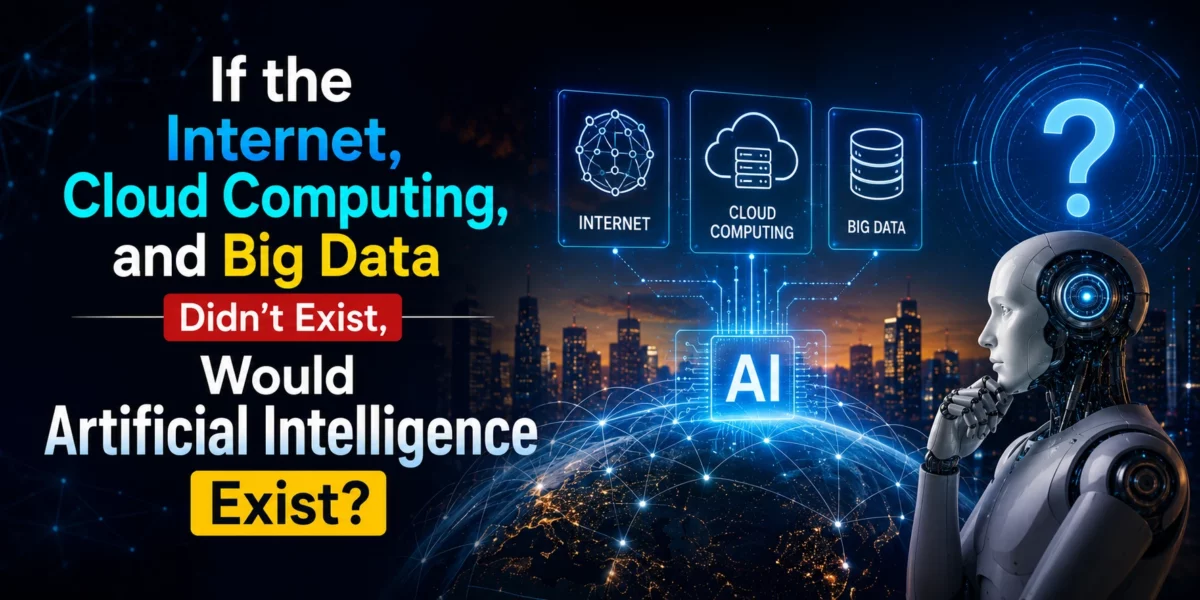
If the Internet, Cloud Computing, and Big Data Didn’t Exist, Would AI Exist?
We live in a world where Artificial Intelligence has quietly become part of almost everything we do, often without us even realizing it. From the moment we check our phones in the morning to the tools we use at work throughout the day, AI is working in the background, shaping decisions, recommendations, and outcomes. Yet very few people stop to ask what actually makes this technology possible, or why it took so long to arrive despite being imagined decades ago.
Artificial Intelligence is everywhere today.
It helps us write emails.
It helps doctors analyze medical information.
It helps businesses forecast demand.
It helps organizations detect cybersecurity threats.
It helps students learn.
It helps professionals become more productive.
But have you ever wondered:
If the Internet, Cloud Computing, and Big Data Didn’t Exist, Would Artificial Intelligence Exist?
The answer is both simple and fascinating.
Yes, AI Would Exist. But Not in the Form We Know Today.
To understand why, we need to look at the history of Artificial Intelligence, and how it was shaped by decades of technological development that came both before and after the concept itself was born.
AI Is Older Than the Internet
Many people assume AI is a modern invention. In reality, the foundations of Artificial Intelligence were laid long before most of the digital tools we rely on today ever existed.
AI concepts were discussed in the 1950s.
Researchers dreamed of creating machines that could:
- Solve problems
- Learn from experience
- Recognize patterns
- Make decisions
These were not small ambitions. Researchers at the time were imagining machines that could think and reason in ways that mirrored human cognition, even though the tools available to them were extremely limited compared to what exists today.
The vision existed long before:
- The Internet
- Smartphones
- Cloud Computing
- Social Media
- Big Data
The idea was there.
The infrastructure was not.
This gap between vision and infrastructure is one of the most important reasons AI took so long to become part of everyday life. A powerful idea without the right supporting technology often remains theoretical for decades.
AI Without the Internet
Artificial Intelligence could still exist without the Internet. In fact, early AI research was conducted entirely offline, using local computers, hand-collected data, and standalone systems.
For example:
- A factory could use AI to monitor equipment.
- A hospital could use AI to analyze medical images.
- A business could use AI to forecast sales.
Everything would happen locally.
However, AI systems would have major limitations. Without a network connecting different systems together, every AI application would essentially operate as its own isolated island of intelligence.
Without the Internet:
- Access to information would be limited.
- Collaboration between systems would be difficult.
- Data sharing would be restricted.
- Innovation would be slower.
AI would be isolated rather than connected.
Think of it as having a brilliant employee locked inside one office with no access to the outside world. That employee might still be capable of solving problems within their own room, but they would never benefit from knowledge, updates, or collaboration happening anywhere else.
AI Without Cloud Computing
Cloud Computing changed everything. It transformed AI from a technology available only to a privileged few into something accessible to businesses of nearly every size.
Before the cloud, organizations needed to purchase:
- Servers
- Storage
- Networking equipment
- Data centers
Only large organizations could afford significant computing power. Building and maintaining this kind of infrastructure required massive upfront investment, specialized staff, and ongoing maintenance costs that smaller organizations simply could not justify.
Without cloud computing:
- AI would be expensive.
- AI would be slower to develop.
- Small businesses would have limited access.
- Innovation would be concentrated among large corporations.
Today, a small business can access computing power that was once available only to governments and multinational organizations. This shift did not just make AI cheaper; it fundamentally changed who was allowed to participate in building and using AI systems.
Cloud Computing democratized AI.
AI Without Big Data
This may be the biggest limitation of all.
AI learns from data.
The more relevant information available, the better AI generally becomes. Data is not just a supporting ingredient for AI; in many ways, it is the primary fuel that determines how capable an AI system can become.
Without Big Data:
- AI would know less.
- AI would learn more slowly.
- Predictions would be less accurate.
- Insights would be more limited.
Imagine trying to teach a child about the world using only a few books.
Now compare that to giving the child access to an entire library.
That is the difference Big Data makes. An AI system trained on a handful of examples will always be limited in what it can recognize and predict, while a system trained on millions or billions of data points can identify patterns that would otherwise remain invisible.
Big Data became the fuel that powers modern AI.
AI Needs Four Things
Modern Artificial Intelligence depends on four major pillars:
- Algorithms – The intelligence framework.
- Computing Power- The ability to process information.
- Data – The knowledge source.
- Connectivity – The ability to access and share information.
Without any one of these pillars, AI becomes less capable.
Without several of them, AI becomes dramatically less useful. Each pillar reinforces the others, which is why the absence of even one can significantly limit what an AI system is able to achieve.
The Perfect Storm
What we are witnessing today is not the sudden appearance of AI.
We are witnessing the convergence of multiple technological revolutions, each one building on the one before it.
- The Computer Revolution – Provided processing power.
- The Internet Revolution – Connected people and information.
- The Cloud Revolution – Provided affordable computing resources.
- The Big Data Revolution – Provided enormous amounts of information.
- The AI Revolution – Brought everything together.
This is why AI became mainstream only recently despite being discussed for more than 70 years. It was not a lack of imagination that delayed AI’s rise; it was a lack of the surrounding infrastructure needed to make that imagination practical.
What Can We Learn From This?
Every major technological breakthrough depends on previous breakthroughs.
The Internet enabled Cloud Computing.
Cloud Computing enabled Big Data.
Big Data accelerated AI.
AI is now enabling new innovations that may shape the next technological revolution.
This is why technology should never be viewed in isolation.
Innovation often occurs when multiple technologies mature at the same time. It is rarely a single breakthrough that changes the world, but rather the moment when several mature technologies finally align and reinforce one another.
What Does This Mean for Your Career?
Many people think AI is only for programmers.
The reality is that AI increasingly affects:
- Healthcare
- Accounting and Finance
- Human Resources
- Supply Chain and Logistics
- Marketing and Sales
- Business Administration
- Cybersecurity
- Information Technology
The professionals who understand how these technologies work together may be better positioned for future opportunities. Understanding the relationship between the Internet, Cloud Computing, Big Data, and AI is quickly becoming as important as understanding basic computer operations once was.
Understanding AI today is similar to understanding computers in the 1980s or the Internet in the 1990s.
It is becoming part of modern literacy.
How Canadian College for Higher Studies Can Help
At Canadian College for Higher Studies (CCHS), we help students, professionals, employers, and career changers prepare for the technologies driving the AI revolution.
Modern Artificial Intelligence depends heavily on cloud computing, cybersecurity, data analytics, Linux platforms, enterprise infrastructure, automation, and governance. Our programs are designed to develop skills in these areas, giving learners the foundation they need to work confidently within AI-enabled environments.
Diploma in Prompt Engineering and Generative AI for Office Professionals
Using Prompt Engineering and Generative AI to automate business processes, enhance workplace productivity, create professional content, improve communication, and support intelligent decision-making across modern office environments in just four months.
Students develop skills in:
- Designing effective prompts for Generative AI applications
- Creating professional business documents, reports, and presentations using AI
- Automating routine office tasks with AI-powered tools
- Generating high-quality marketing, HR, administrative, and customer service content
- Analyzing data and producing AI-assisted business insights
- Developing AI-powered workflows and no-code automations
- Using AI to improve communication and workplace productivity
- Applying AI for research, problem-solving, and decision support
- Creating AI-assisted emails, proposals, policies, and business correspondence
- Using AI for meeting summaries, note-taking, and knowledge management
- Developing ethical, responsible, and secure AI practices
- Integrating AI into business, education, healthcare, and administrative environments
- Evaluating AI-generated content for accuracy, quality, and compliance
- Applying Prompt Engineering techniques for text, image, and multimedia generation
- Building practical AI solutions through real-world business projects
Diploma in Cloud-Based IT Support & Cybersecurity
Building the technical skills to support, secure, troubleshoot, and manage modern enterprise IT and cloud infrastructure.
Students develop skills in:
- Supporting users in Windows, Linux, and cloud-based environments
- Installing, configuring, and troubleshooting computer systems and networks
- Managing Microsoft 365, Active Directory, and enterprise user accounts
- Administering Windows Server and Enterprise Linux systems
- Configuring and securing wired and wireless networks
- Supporting cloud services across AWS, Microsoft Azure, and Google Cloud
- Detecting, preventing, and responding to cybersecurity threats
- Implementing endpoint, network, and cloud security best practices
- Managing identity, access control, and multi-factor authentication (MFA)
- Monitoring, troubleshooting, and optimizing IT infrastructure
- Automating routine IT administration tasks using scripting tools
- Performing backup, disaster recovery, and business continuity operations
- Delivering professional technical support and incident management
- Troubleshooting hardware, software, networking, and cloud issues
- Supporting virtualization and remote desktop environments
- Applying cybersecurity frameworks and industry best practices
Diploma in Cybersecurity & AI-Driven Threat Detection
Building, securing, monitoring, and defending modern enterprise and cloud environments using AI-driven threat detection, ethical hacking, digital forensics, and security automation..
Students develop skills in:
- Detecting and responding to cyber threats using Artificial Intelligence
- Monitoring enterprise security using AI-powered SIEM platforms
- Performing threat hunting and threat intelligence analysis
- Conducting ethical hacking and vulnerability assessments
- Investigating security incidents through digital forensics
- Analyzing malware using AI-assisted detection techniques
- Securing cloud, containerized, serverless, and IoT environments
- Automating cybersecurity operations using Python and security tools
- Implementing Security Operations Centre (SOC) processes and incident response
- Applying cybersecurity governance, compliance, and AI governance principles
- Monitoring enterprise networks and cloud infrastructure for suspicious activity
- Protecting enterprise systems against ransomware, phishing, insider threats, and advanced persistent threats (APTs)
- Communicating security risks and recommendations to technical and business stakeholders
- Integrating AI, cloud security, and automation through real-world capstone projects
Diploma in Cloud Data Analytics & Edge AI Security
Building secure cloud-based analytics and Edge AI solutions that enable real-time patient monitoring, AI-assisted diagnostics, early disease detection, predictive healthcare analytics, and intelligent clinical decision support.
Students develop skills in:
- Building secure cloud-based healthcare analytics solutions
- Applying Edge AI for real-time patient monitoring
- Supporting AI-assisted patient diagnostics and clinical decision-making
- Developing predictive analytics for early disease detection
- Integrating IoT medical devices with cloud analytics platforms
- Processing real-time data from wearable and remote patient monitoring devices
- Designing healthcare dashboards for patient outcomes and operational intelligence
- Securing healthcare information, medical devices, and connected systems
- Implementing healthcare data governance, privacy, and regulatory compliance
- Leveraging AI for intelligent healthcare analytics and operational efficiency
Advanced Diploma in Security and Automation of Multi-Cloud Containerized Workloads
Master Kubernetes, Containerization, Cloud Automation & DevSecOps
Preparing professionals to build, secure, automate, and orchestrate containerized applications across hybrid and multi-cloud environments using Kubernetes.
Students develop skills in:
- Building and managing Kubernetes clusters
- Containerizing enterprise applications with Docker
- Automating cloud infrastructure and deployments
- Orchestrating workloads across hybrid and multi-cloud environments
- Securing cloud-native applications and containers
- Implementing CI/CD pipelines and DevSecOps practices
- Monitoring, scaling, and optimizing cloud workloads
- Managing enterprise Linux cloud infrastructure
- Deploying highly available and resilient applications
- Modernizing enterprise IT with cloud-native technologies
Diploma in Enterprise Linux & Application Security Engineering
Building, securing, automating, and optimizing Enterprise Linux infrastructure and application platforms for high-performance, mission-critical business environments..
Students develop skills in:
- Installing, configuring, and administering Enterprise Linux servers
- Managing enterprise users, permissions, file systems, and storage
- Securing Linux operating systems and enterprise applications
- Deploying and managing Apache, Nginx, and enterprise web servers
- Administering application servers and middleware platforms
- Automating Linux administration using Bash scripting and Ansible
- Managing enterprise networking, DNS, DHCP, SSH, and firewall services
- Implementing Identity and Access Management (IAM) and privilege controls
- Hardening Linux servers using industry security best practices
- Monitoring, troubleshooting, and optimizing enterprise Linux environments
- Managing virtualization and Linux-based cloud infrastructure
- Securing databases, web applications, and application services
- Performing backup, disaster recovery, and high-availability configuration
- Managing enterprise logging, auditing, and compliance
- Deploying secure enterprise applications in production environments
- Troubleshooting complex Linux infrastructure and application issues
Post-Graduate Diploma in Enterprise Cybersecurity & Governance Automation
Designing, governing, and automating enterprise cybersecurity using AI, Zero Trust, DevSecOps, cloud security, and intelligent governance to protect modern digital enterprises.
Students develop skills in:
- Designing enterprise cybersecurity architectures
- Implementing Zero Trust security frameworks
- Securing hybrid and multi-cloud environments
- Automating security operations using AI and SOAR platforms
- Managing Security Operations Centres (SOC) and incident response
- Implementing Governance, Risk, and Compliance (GRC) frameworks
- Conducting enterprise risk assessments and security audits
- Automating compliance and security policy enforcement
- Implementing Identity and Access Management (IAM) and Privileged Access Management (PAM)
- Securing Kubernetes, containers, cloud-native, and serverless environments
- Designing DevSecOps pipelines and secure software delivery
- Deploying SIEM, threat intelligence, and AI-driven threat detection
- Managing enterprise vulnerability assessment and penetration testing
- Developing cybersecurity governance, security metrics, and executive reporting
- Applying Infrastructure as Code (IaC) and security automation
- Designing disaster recovery, business continuity, and cyber resilience strategies
- Leading enterprise cybersecurity transformation and governance initiatives
- Developing real-world enterprise cybersecurity automation projects
Advanced Diploma in AI, Deep Learning & Natural Language Processing
Designing, developing, training, deploying, and securing Artificial Intelligence, Deep Learning, and Natural Language Processing solutions for intelligent automation, business innovation, and real-world decision-making.
Students develop skills in:
- Designing and developing Artificial Intelligence applications
- Building deep learning models using modern AI frameworks
- Developing Natural Language Processing (NLP) solutions
- Creating Generative AI and Large Language Model (LLM) applications
- Developing AI-powered chatbots and virtual assistants
- Building computer vision and image recognition systems
- Applying AI for speech recognition and language understanding
- Engineering machine learning and predictive analytics solutions
- Deploying AI models using MLOps and cloud platforms
- Optimizing AI model performance and scalability
- Implementing AI ethics, governance, and responsible AI practices
- Securing AI systems, models, and data pipelines
- Developing AI applications for healthcare, finance, manufacturing, and business
- Integrating AI with cloud computing, APIs, and enterprise applications
- Building intelligent automation and decision support systems
- Developing real-world AI solutions through enterprise capstone projects
Diploma in Cloud and Cybersecurity Technologies
Building, securing, automating, and managing modern cloud and enterprise IT infrastructure through an integrated curriculum aligned with the major knowledge domains of leading industry certifications.
- Configuring and administering a Cloud platform
- Deploying virtualized infrastructure and cloud networking solutions
- Securing enterprise systems using firewalls, VPNs, encryption, and identity management
- Performing vulnerability assessments and implementing cybersecurity best practices
- Monitoring, detecting, and responding to security incidents using modern security tools
- Administering Linux/Unix systems for enterprise and cloud environments
- Applying industry security frameworks including NIST, OWASP, and ISO 27001
- Troubleshooting cloud, network, and cybersecurity environments through hands-on projects
- Developing practical skills aligned with the major knowledge domains of leading industry certifications in cloud computing, networking, Linux, and cybersecurity.
One-Day Workshops and Corporate Training
Organizations can also benefit from practical training in:
- Artificial Intelligence for Business Professionals
- AI Productivity and Automation
- Cloud Fundamentals for Business Leaders
- Cybersecurity Awareness
- AI for Supply Chain and Logistics Professionals
- Business Forecasting and Analytics
- Data Analytics for Managers
- Digital Transformation Fundamentals
Whether you are preparing for a career in cloud computing, Linux administration, cybersecurity, AI, analytics, automation, or enterprise governance, understanding how these technologies work together is becoming increasingly important in today’s AI-powered economy.
One-Day Workshops
Including:
- Artificial Intelligence for Business Professionals
- AI Productivity and Automation
- AI for Accounting and Payroll Professionals
- AI for Healthcare Administration
- AI for Supply Chain and Logistics Professionals
- Business Forecasting and Analytics
Funding Opportunities May Be Available
For eligible individuals:
- Better Jobs Ontario (BJO)
- Career Transition Programs
For eligible employers:
- Ontario Job Grant (OJG)
- Workforce Development Initiatives
The Bigger Question
Perhaps the most interesting question is not:
“Would AI exist without the Internet, Cloud Computing, and Big Data?”
The answer is yes.
But it would be far less powerful.
The more important question is:
“What will AI become as technology continues to evolve?”
History suggests we are only at the beginning.
The AI revolution may not be the destination.
It may simply be the next chapter in a much larger story, one that will likely be shaped by technologies that have not yet fully matured.
About the Author
Donatus Doss
President, Canadian College for Higher Studies (CCHS)
Having worked through the Computer Revolution, the network revolution,the Internet Revolution, the Cloud Revolution, the Big Data Revolution, and now the AI Revolution, Donatus Doss continues to help individuals and organizations understand how technology can improve productivity, decision-making, workforce development, and business success.
Frequently Asked Questions
Yes, AI could still exist without the Internet, but it would function locally and in isolation. Systems like factory equipment monitors or hospital imaging tools could still work, but data sharing and collaboration between systems would be extremely limited.
Cloud Computing removed the need for organizations to buy expensive servers and data centers. This democratized AI, allowing small businesses to access computing power once available only to governments and large multinational corporations.
AI learns from data, so more relevant information generally leads to better performance. Without Big Data, AI would know less, learn more slowly, and produce less accurate predictions, similar to teaching a child from just a few books instead of a library.
Modern AI depends on Algorithms, Computing Power, Data, and Connectivity. Removing any one of these pillars makes AI less capable, and removing several at once makes AI dramatically less useful in real-world applications.
AI ideas existed for over 70 years, but the required infrastructure did not. It took the convergence of the Computer, Internet, Cloud, and Big Data revolutions before AI could become the powerful, accessible technology we see today.
CCHS offers diplomas including Prompt Engineering and Generative AI for Office Professionals, Cloud-Based IT Support & Cybersecurity, Cybersecurity with AI, Cloud Data Analytics & Edge AI Security, and Advanced Diploma in AI, Deep Learning & Natural Language Processing, along with related one-day workshops.