

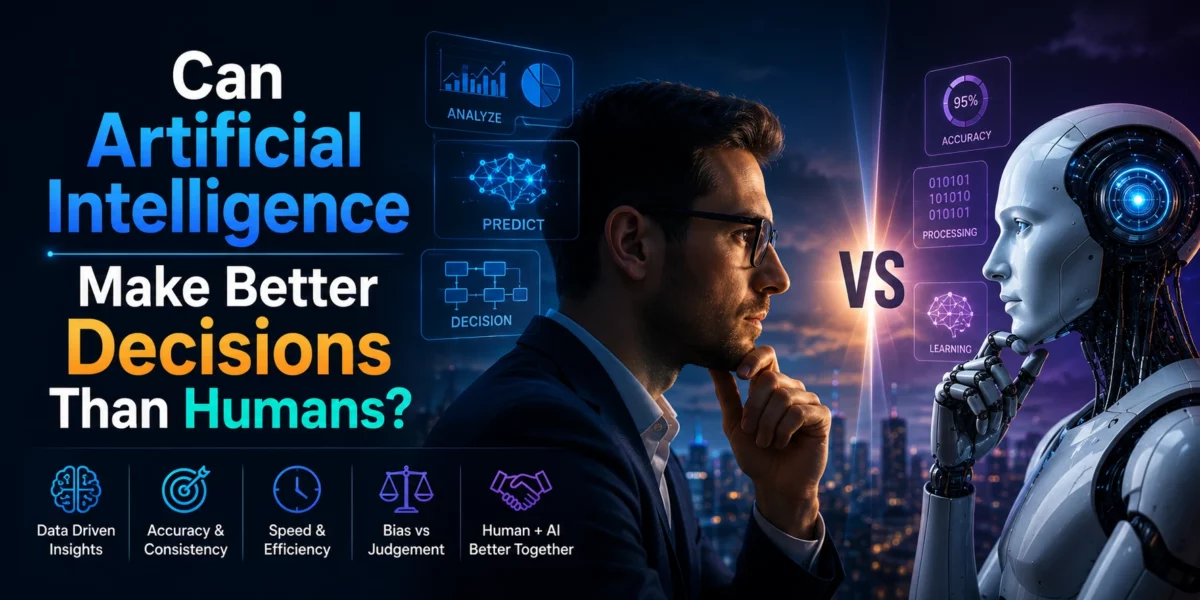
Every day, decisions shape the outcome of businesses, careers, and even personal lives. Some decisions are small and routine, while others carry significant consequences for an organization’s future. As Artificial Intelligence becomes more capable, a natural question arises: can a machine make better decisions than a human being? The answer is more nuanced than a simple yes or no, and understanding it requires looking back at how the relationship between humans and technology has evolved over time.
For many years, I taught Computer Literacy and often shared a simple principle:
Humans can do things fast but not always accurately.
Humans can do things accurately but not always fast.
When humans and computers work together, the result can be both fast and accurate.
That principle helped many people understand the value of computers in the workplace.
At the time, computers were powerful tools, but they were not intelligent.
They could:
- Calculate
- Store information
- Process transactions
- Follow instructions
But they could not:
- Think
- Learn
- Reason
- Predict
- Create
- Make recommendations
The human supplied the intelligence.
The computer supplied the speed and accuracy.
Today, Artificial Intelligence has changed the equation. Unlike traditional computers, AI systems are no longer limited to simply following fixed instructions. They can now analyze, learn, and generate insights in ways that begin to resemble aspects of human reasoning.
Which raises an important question:
Can Artificial Intelligence Make Better Decisions Than Humans?
The answer is both yes and no.
But perhaps we are asking the wrong question.
AI Is Changing What Technology Can Do
For the first time in history, technology is doing more than processing information. It is beginning to participate in the thinking process itself, rather than simply executing commands given by a human operator.
AI can now:
- Analyze enormous amounts of data
- Identify patterns
- Generate insights
- Predict outcomes
- Recommend actions
- Learn from historical information
- Assist with problem-solving
This allows AI to support decisions in ways traditional computers never could. It shifts the role of technology from a passive tool to an active contributor in the decision-making process.
In Some Situations, AI Can Outperform Humans
Artificial Intelligence has several advantages that make it uniquely suited to certain types of tasks.
It Can Analyze More Information
A human manager may review a few reports.
An AI system can analyze:
- Millions of transactions
- Years of business data
- Customer behavior patterns
- Supply chain activities
- Healthcare records
- Market trends
within seconds. No human being, no matter how experienced, could manually process this volume of information in a comparable amount of time.
It Can Identify Hidden Patterns
AI often discovers relationships and trends that humans may overlook, simply because the human brain is not built to track thousands of variables simultaneously.
Examples include:
- Fraud detection in banking
- Demand forecasting in supply chains
- Predictive maintenance in manufacturing
- Patient risk identification in healthcare
- Cybersecurity threat detection
It Can Work Continuously
Humans become tired.
Humans become distracted.
Humans experience stress.
AI systems can operate continuously and consistently, without the natural dips in focus and energy that affect human performance throughout the day.
It Can Respond Faster
In situations such as:
- Cybersecurity monitoring
- Equipment diagnostics
- Patient monitoring
- Financial transaction analysis
AI can often identify issues much faster than humans, which can be the difference between preventing a problem and reacting to one after damage has already occurred.
But Humans Still Have Advantages
Artificial Intelligence remains a tool.
A very powerful tool.
But still a tool.
Humans continue to excel in areas such as:
Judgment
Not every decision can be reduced to data.
Business leaders often make decisions involving:
- Ethics
- Organizational culture
- Human relationships
- Long-term strategy
These are areas where numbers alone rarely tell the full story, and human judgment remains essential.
Creativity
Humans continue to demonstrate unique abilities in:
- Innovation
- Leadership
- Vision
- Entrepreneurship
Creativity often involves connecting ideas in unexpected ways, something that still relies heavily on human imagination and lived experience.
Understanding Context
A human may recognize factors that are not captured in a database.
For example:
- Employee morale
- Customer emotions
- Community impact
- Political considerations
These contextual factors often influence outcomes just as much as the raw data itself, and they are far harder for a machine to fully capture.
Responsibility
Organizations still need people to take responsibility for decisions and outcomes. Accountability is fundamentally a human concept, and it remains an essential part of how businesses and institutions operate.
The Real Question Is Not AI vs Humans
Many people ask:
“Will AI replace human decision-makers?”
A better question may be:
“What happens when human intelligence and artificial intelligence work together?“
This is where the greatest opportunity exists. Rather than viewing AI and humans as competitors, it may be more useful to view them as partners, each contributing different strengths to the decision-making process.
The New Equation
In the computer era, I taught:
Human Intelligence + Computer Speed = Better Results
Today, the equation has evolved.
Human Intelligence + Artificial Intelligence = Amplified Intelligence
The outcome is no longer simply:
- Faster
- More Accurate
The outcome can also be:
- More Productive
- More Insightful
- More Predictive
- More Consistent
- More Innovative
- Better Informed
The computer revolution increased our productivity.
The AI revolution is amplifying our capability. It is not simply speeding up old processes; it is enabling entirely new types of decisions that were not previously possible.
Real-World Examples
Healthcare
AI can:
- Analyze medical images
- Monitor patient conditions
- Identify potential risks
Healthcare professionals:
- Interpret findings
- Apply clinical judgment
- Make treatment decisions
Supply Chain & Logistics
AI can:
- Forecast demand
- Optimize inventory
- Predict delays
Managers:
- Balance business objectives
- Manage supplier relationships
- Make strategic decisions
Accounting & Finance
AI can:
- Analyze financial data
- Detect anomalies
- Generate reports
Accountants:
- Interpret results
- Advise management
- Ensure compliance
Human Resources
AI can:
- Screen resumes
- Analyze workforce trends
HR professionals:
- Evaluate candidates
- Build relationships
- Make hiring decisions
Across every one of these fields, the pattern is the same: AI handles the scale and speed, while humans provide the judgment and accountability that ultimately shape the final decision.
What Does This Mean for Your Career?
The future workplace will increasingly reward professionals who know how to combine:
- Human expertise
- Industry knowledge
- Critical thinking
with:
- Artificial Intelligence
- Data Analytics
- Business Intelligence
- Automation Tools
- Predictive Technologies
The professionals who learn to use AI effectively may gain a significant advantage over those who choose to ignore it. This is not about competing with AI, but about learning to work alongside it in a way that strengthens both parties.
How Canadian College for Higher Studies Can Help
At Canadian College for Higher Studies (CCHS), we help students, professionals, employers, and career changers prepare for a future where AI increasingly supports decision-making.
Diploma Programs
Including:
- Prompt Engineering and Generative AI for Office Professionals
- Medical & Health Office Administration (with Digital Health Technologies)
- Graphic Design, Web Design & Digital Marketing (AI-driven)
- Business Administration (with Data Analytics & Decision Intelligence)
- International Business Management
- Supply Chain & Logistics Management
- Computerized Accounting & Office Administration
- Cloud-Based IT Support & Cybersecurity
- Diploma in Cybersecurity & AI-Driven Threat Detection
- Cloud Data Analytics & Edge AI Security (for healthcare data analytics, patient monitoring, and intelligent clinical decision support)
One-Day Workshops
Including:
- Artificial Intelligence for Business Professionals
- AI Productivity and Automation
- Business Forecasting and Analytics
- Data Analytics for Managers
- AI for Accounting and Payroll Professionals
- AI for Healthcare Administration
- AI for Supply Chain and Logistics Professionals
Micro-Skills Training
Practical programs designed to help professionals develop AI literacy, analytics capabilities, forecasting skills, and technology-enabled decision-making abilities.
Funding Opportunities May Be Available
For Individuals
Eligible individuals may wish to explore:
- Better Jobs Ontario (BJO)
- Career Transition Programs
- Workforce Development Initiatives
For Employers
Organizations may wish to explore:
- Ontario Job Grant (OJG)
- Employer Workforce Development Programs
- Employee Upskilling Initiatives
Eligible employers may be able to receive support for approved employee training and workforce development programs.
The Future Belongs to Better Decision-Makers
Artificial Intelligence may never completely replace human judgment.
But it is already transforming how decisions are made.
The organizations and professionals who thrive in the coming years will likely be those who understand how to combine the strengths of both.
Human Intelligence provides wisdom.
Artificial Intelligence provides scale.
Together, they can create outcomes neither could achieve alone.
The question is no longer:
“Can AI make better decisions than humans?”
The better question is:
“How can humans and AI make better decisions together?”
About the Author
Donatus Doss
President, Canadian College for Higher Studies (CCHS)
Donatus Doss has spent more than four decades helping individuals and organizations prepare for technological change. In the 1980s, he taught Computer Literacy and promoted the message that technology should be used to enhance human capability. Today, he believes Artificial Intelligence represents the next major transformation in how people learn, work, solve problems, and make decisions.
Frequently Asked Questions
No. While AI can analyze vast amounts of data quickly, humans still excel at judgment, creativity, understanding context, and taking responsibility for outcomes. AI works best as a partner to human intelligence, not a replacement for it.
AI outperforms humans in analyzing large volumes of data, identifying hidden patterns, working continuously without fatigue, and responding faster in areas like cybersecurity monitoring, fraud detection, and equipment diagnostics.
The article describes it as Human Intelligence + Artificial Intelligence = Amplified Intelligence. This means combining human judgment with AI’s speed and scale produces outcomes that are more productive, insightful, and innovative than either could achieve alone.
AI can analyze medical images, monitor patient conditions, and identify potential risks. However, healthcare professionals still interpret findings, apply clinical judgment, and make final treatment decisions based on that AI-generated information.
Humans provide judgment, creativity, contextual understanding, and accountability, areas where data alone cannot provide complete answers. Organizations still need people to take responsibility for decisions and their outcomes.
CCHS offers diplomas like Prompt Engineering and Generative AI for Office Professionals Cloud Data Analytics & Edge AI Security and Cybersecurity with Artificial Intelligence, along with one-day workshops such as AI for Business Professionals and Business Forecasting and Analytics. All our diplomas cover modern technologies.
Latest Post
- What Is Agentic AI? Skills, Careers & Future Job Opportunities
- Best Courses to Get a Job in Canada After Graduation
- AI, IoT and Edge Computing: How These Technologies Work Together
- AI-Powered Cyber Attacks: What Students & Businesses Must Know
- What Is Healthcare Administration and Is It Good in Canada?