

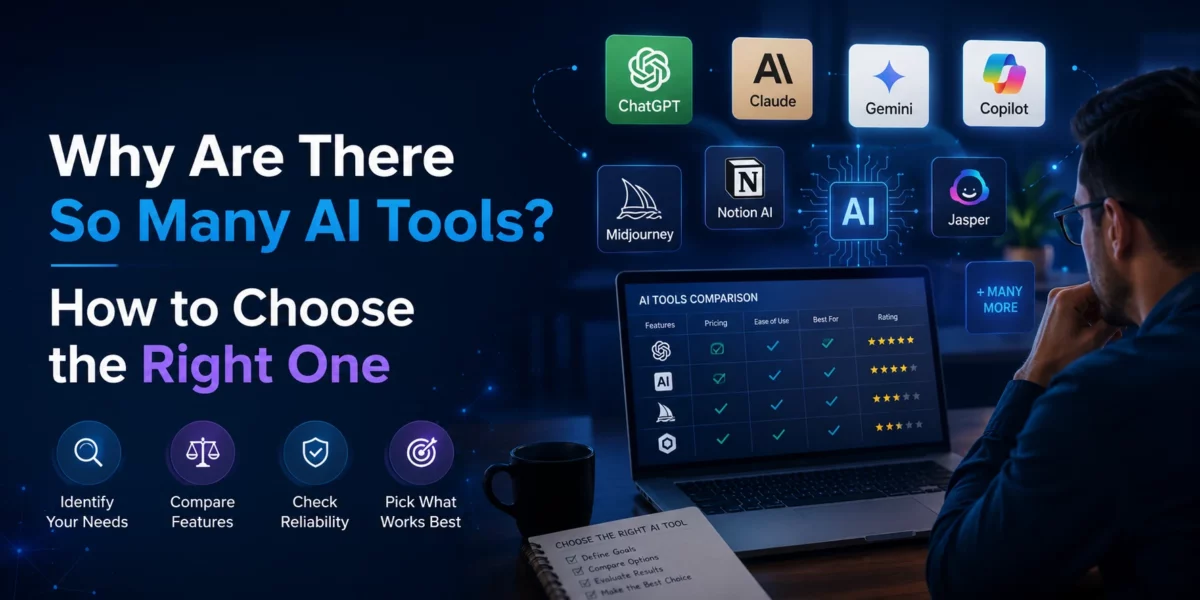
The AI Marketplace Is Growing Faster Than Most People Expected
If you have searched for Artificial Intelligence tools recently, you may have noticed something surprising.
There are now hundreds of AI tools available – and that number keeps climbing.
Every week, new platforms seem to appear, each promising to improve productivity, automate tasks, generate content, analyze data, support decision-making, improve customer service, enhance cybersecurity, or transform business operations entirely. The pace of release is staggering, and for many individuals and business owners, it creates more confusion than clarity.
You open a browser, search for “AI tools for my business,” and within minutes you are looking at dozens of options – each with its own pricing model, feature set, target audience, and bold claims about what it can do for you. Some are free. Some cost thousands of dollars per month. Some are designed for individuals. Others are built for enterprise teams. Some are general-purpose. Others are hyper-specialized for a single industry or task.
This leaves many individuals and business owners asking a very reasonable question:
Why Are There So Many AI Tools?
And perhaps more importantly:
How Do I Know Which One Is Right for Me?
These are not simple questions. But they are the right questions to be asking – and understanding the answers is the first step toward making smart decisions about AI adoption.
The AI Gold Rush Has Begun
To understand why so many AI tools exist, it helps to understand the economic forces driving their creation.
Artificial Intelligence is one of the fastest-growing technology sectors in history. The underlying technologies – machine learning, large language models, computer vision, natural language processing, and predictive analytics – have matured significantly over the past several years, reaching a point where they can deliver genuinely useful, commercially viable products at a cost that makes widespread deployment practical.
Organizations around the world are investing billions of dollars into AI technologies because they see opportunities to:
- Increase productivity
- Reduce costs
- Improve customer experiences
- Automate repetitive tasks
- Analyze data more effectively
- Improve decision-making
- Enhance innovation
When the market signals are this strong, software companies respond. Startups launch. Established technology companies pivot. Developers build. Venture capital flows. The result is an explosion of products – each targeting a specific use case, a specific industry, or a specific type of user.
This is why hundreds of AI tools now exist, and why dozens more will appear before the end of this year. The AI gold rush is well underway, and for the foreseeable future, the marketplace will continue to grow and evolve at a pace that is genuinely difficult to keep up with.
For individuals and organizations trying to navigate this landscape, the sheer volume of options can feel paralyzing. The good news is that navigating it becomes much more manageable once you understand that not all AI tools are designed to do the same thing.
Not All AI Tools Are Designed for the Same Purpose
One of the most common misconceptions about AI tools is that they are largely interchangeable – that any AI platform can handle any task, and the differences between them are mainly cosmetic.
This is not the case.
AI tools are designed for very different objectives, and choosing one that does not match your actual needs is a fast path to frustration, wasted money, and poor results. Understanding the major categories of AI tools is an important first step in making an informed choice.
Content Creation and Communication
Some of the most widely used AI tools fall into this category. These are platforms designed to help users work with language – drafting, editing, summarizing, and communicating more effectively.
Examples include tools that help:
- Draft emails
- Create reports
- Generate marketing content
- Prepare presentations
- Summarize information
Tools like these are valuable for professionals who spend significant time on written communication and content production. But they are not designed to analyze your sales data or monitor your network for cybersecurity threats.
Business Productivity
A second major category focuses on helping organizations work more efficiently at an operational level.
These tools help organizations:
- Improve workflows
- Automate repetitive tasks
- Increase employee productivity
- Support project management
Many of these tools integrate with existing software platforms – email clients, calendar systems, project management tools – to reduce friction and help teams accomplish more in less time.
Data Analytics and Business Intelligence
For organizations that need to make sense of large volumes of business data, a growing category of AI tools is specifically designed for analytics and intelligence.
These tools help organizations:
- Analyze business data
- Create dashboards
- Forecast trends
- Support decision-making
These are not general-purpose productivity tools. They are built for organizations that need to turn raw data into actionable insight – and they require a degree of data literacy to use effectively.
Supply Chain and Logistics
AI is increasingly used across supply chain operations, where complexity and scale make intelligent automation particularly valuable.
Applications include:
- Demand forecasting
- Inventory optimization
- Transportation planning
- Risk management
A retailer trying to manage inventory across dozens of locations, or a logistics company trying to optimize delivery routes across thousands of shipments, has very specific AI needs that a general-purpose productivity tool simply cannot address.
Healthcare
Healthcare organizations are among the most active adopters of specialized AI solutions, for good reason. The combination of large data volumes, high stakes, and complex documentation requirements makes healthcare an ideal environment for AI assistance.
Healthcare organizations use AI for:
- Patient monitoring
- Healthcare analytics
- Documentation support
- Administrative efficiency
The regulatory requirements, data privacy standards, and clinical context of healthcare make industry-specific AI tools far more appropriate than generic alternatives.
Cybersecurity
Cybersecurity is another area where specialized AI tools have become increasingly important – and where the wrong tool, or no tool, can have serious consequences.
AI tools in this space can help:
- Detect threats
- Monitor networks
- Identify vulnerabilities
- Support incident response
The speed and scale at which modern cyber threats operate makes AI-assisted detection and response not just useful, but increasingly necessary for organizations that want to maintain effective security.
The Real Problem Is Not Finding AI Tools
Given how many AI tools now exist, finding options is rarely the challenge. A quick web search will surface more options than any individual or organization could reasonably evaluate.
The real challenge is selecting the right tools.
And this is where many organizations – and many individuals – run into serious problems.
Mistake #1: Buying Too Many Tools
Organizations often purchase multiple AI solutions before truly understanding how those tools fit into their existing business processes, team workflows, or strategic objectives.
The appeal is understandable. AI is generating enormous excitement, and the fear of falling behind competitors can push decision-makers into moving quickly without moving thoughtfully.
But buying too many AI tools without a clear strategy can create:
- Unnecessary costs
- Employee confusion
- Duplicate functionality
- Poor adoption rates
A team that is juggling five different AI platforms – each with its own interface, learning curve, and workflow integration requirements – is unlikely to use any of them well. Adoption suffers, return on investment falls short of expectations, and the organization ends up more frustrated than when it started.
Mistake #2: Choosing the Wrong Tool
Popularity is not the same as suitability.
The most widely discussed AI tool, or the one with the most impressive marketing, may be entirely wrong for your specific needs. A marketing department, healthcare clinic, accounting firm, manufacturer, and logistics company will likely require very different AI strategies – even if they are all the same size, in the same city, and have the same budget.
Choosing the wrong tool means paying for features you do not need, missing the features you do need, and investing time in training employees on a platform that was never designed for your use case.
Before Choosing an AI Tool, Ask These Questions
The most effective approach to AI tool selection starts not with the tools themselves, but with a clear understanding of your own needs, your team, and your objectives. Before evaluating a single platform, it is worth working through a set of fundamental questions.
What Problem Are You Trying to Solve?
This sounds obvious, but it is the question that is most often skipped in the excitement of evaluating new technology.
Are you looking to:
- Increase productivity?
- Improve customer service?
- Automate reporting?
- Analyze business data?
- Improve cybersecurity?
- Optimize supply chain operations?
The right solution depends entirely on the problem. An AI writing assistant will not help you detect network intrusions. A cybersecurity monitoring platform will not help you draft marketing copy. Getting clear on the specific problem you are trying to solve before you start looking at tools will save you significant time, money, and frustration.
Who Will Use the Tool?
Different users have different needs, different technical backgrounds, and different tolerances for complexity.
- Business Owners
- Managers
- Accountants
- Healthcare Administrators
- Marketing Professionals
- Supply Chain Teams
- IT Professionals
The best AI tool for one group may be completely unsuitable for another. An enterprise-grade data analytics platform designed for data scientists may be powerful, but it will not be useful if your team consists of accountants who have no data science background. Matching the tool to the actual user is just as important as matching it to the task.
What Is Your Budget?
AI tools range enormously in cost. Some organizations spend thousands of dollars per month on enterprise AI platforms with advanced features, dedicated support, and deep integration capabilities.
Others achieve excellent results using affordable or even free tools, combined with proper training that helps their teams get the most out of what they have.
Understanding your budget – and understanding that an expensive tool is not automatically a better tool – is an important part of making a smart decision.
What Skills Do Employees Have?
This is perhaps the most underestimated factor in AI tool selection.
The most powerful AI platform available provides little value if the people who are supposed to use it do not know how to use it effectively. A tool that requires a high level of technical proficiency will underperform – or sit unused – in an organization whose employees have not received the right training.
This is one reason workforce training is becoming just as important as technology selection in modern organizations. Choosing the right tool and equipping your people to use it effectively are two sides of the same coin.
Technology Is Only Part of the Solution
This brings us to one of the most important points about AI adoption that is often overlooked in the excitement of technology selection.
Many organizations focus almost entirely on selecting software. They compare features, read reviews, request demos, and negotiate pricing – and then they deploy the tool and expect results.
The most successful organizations understand that technology adoption is as much about people as it is about platforms.
Employees need to understand:
- How AI works
- What it can and cannot do
- Best practices for using AI responsibly
- Data privacy considerations
- Security risks
- Industry-specific applications
Without this understanding, employees may use AI tools incorrectly, inefficiently, or in ways that create unintended risks. They may distrust the technology and avoid using it. They may use it for the wrong tasks. They may rely on it too heavily in situations where human judgment is essential.
Without training, organizations often fail to achieve the expected return on their AI investments – not because the technology did not work, but because the people using it were not prepared to use it well.
This is why the conversation about AI adoption must always include a conversation about education and workforce development.
How Canadian College for Higher Studies Can Help
At Canadian College for Higher Studies (CCHS), we help individuals and organizations understand the rapidly evolving AI landscape – not by overwhelming them with options, but by helping them think clearly about what they actually need.
Our goal is not simply to recommend software.
Our goal is to help you identify practical solutions that align with your objectives, workforce capabilities, and industry requirements – and to equip you and your team with the skills needed to put those solutions to work effectively.
For Individuals
We offer:
- AI Awareness Training
- Micro-Skills Programs
- Career-Focused AI Training
- Business Analytics Training
- Data Analytics Programs
- Diploma Programs Incorporating AI Technologies
Whether you are just beginning to explore AI or looking to formalize your knowledge into recognized credentials, CCHS provides a pathway that fits your goals and your timeline.
For Employers
We offer:
- One-Day AI Workshops
- AI Readiness Assessments
- AI Tool Selection Guidance
- Workforce Development Programs
- Customized Corporate Training
- Digital Transformation Workshops
For organizations navigating AI adoption, CCHS provides both the strategic guidance to make smart decisions and the practical training to ensure your team can execute on them.
Popular Workshop Topics
Our most in-demand workshops cover the areas where organizations are most actively looking for support:
- Artificial Intelligence for Business Professionals
- AI Productivity and Automation
- Microsoft Copilot Essentials
- AI for Accounting and Payroll
- AI for Healthcare Administration
- AI for Supply Chain and Logistics
- Business Forecasting and Analytics
- Data Analytics for Managers
These workshops are designed to deliver immediately applicable knowledge – skills and frameworks that participants can bring back to their organizations and use from day one.
Funding Opportunities May Be Available
The cost of AI training and education is a real consideration for both individuals and organizations. CCHS encourages eligible individuals and employers to explore the funding programs that may be available to help offset those costs.
For Individuals
Eligible individuals may wish to explore:
- Better Jobs Ontario (BJO)
- Career Transition Programs
- Workforce Development Initiatives
For Employers
Organizations may wish to explore:
- Ontario Job Grant (OJG)
- Employer Training Funding Programs
- Workforce Development Initiatives
Eligible employers may be able to receive support for approved employee training and workforce development programs – making it more affordable to invest in the AI literacy and technical skills that their teams need to succeed.
Don’t Choose an AI Tool Before Understanding Your Needs
The AI marketplace will continue to grow. New tools will continue to appear – some genuinely useful, some overhyped, some designed for specific industries that may or may not include yours.
The organizations and professionals that achieve the greatest success with AI will not necessarily be those using the most tools, or the most expensive tools, or the tools that generate the most buzz on social media.
They will be those using the right tools for the right reasons – selected thoughtfully, implemented carefully, and supported by a workforce that has the knowledge and confidence to use them well.
Need Help Choosing the Right AI Tools?
Whether you are an individual exploring career opportunities in Canada’s growing AI economy, or a business owner looking to improve productivity and stay competitive, Canadian College for Higher Studies can help.
We can help you understand the AI landscape, identify the solutions best suited to your specific needs, and develop the skills necessary to succeed in Canada’s emerging AI economy.
Contact us today to learn about our workshops, micro-skills programs, diploma pathways, corporate training solutions, and potential funding opportunities.
Canada’s AI Economy Is Here. Are You Ready?
Frequently Asked Questions
AI tools are multiplying because organizations worldwide are investing heavily in artificial intelligence to boost productivity, cut costs, and gain competitive advantages. This demand has driven a wave of specialized platforms targeting every industry, business function, and user type imaginable.
Start by identifying the specific problem you want to solve before evaluating any tools. Consider who will use it, what your budget allows, and what skills your team currently has. Matching the tool to your actual needs and user base prevents costly mismatches and poor adoption.
More tools do not automatically mean better results. Organizations that adopt too many AI platforms without a clear strategy often face employee confusion, duplicate functionality, and poor adoption rates. Starting with one well-chosen tool, used effectively, typically delivers better returns than juggling several.
Even the most powerful AI platform delivers little value if employees do not know how to use it correctly, responsibly, or efficiently. Without training, organizations frequently fail to achieve expected returns on AI investments – not because the technology failed, but because the workforce was unprepared.
CCHS offers one-day workshops covering topics such as AI for Business Professionals, Microsoft Copilot Essentials, AI for Accounting and Payroll, AI for Healthcare Administration, AI for Supply Chain and Logistics, Business Forecasting, and Data Analytics for Managers – all designed for immediate workplace application.
Yes. Eligible Ontario employers may be able to access funding through programs such as the Ontario Job Grant and other workforce development initiatives to offset the cost of employee AI training, workshops, and development programs offered through CCHS.