

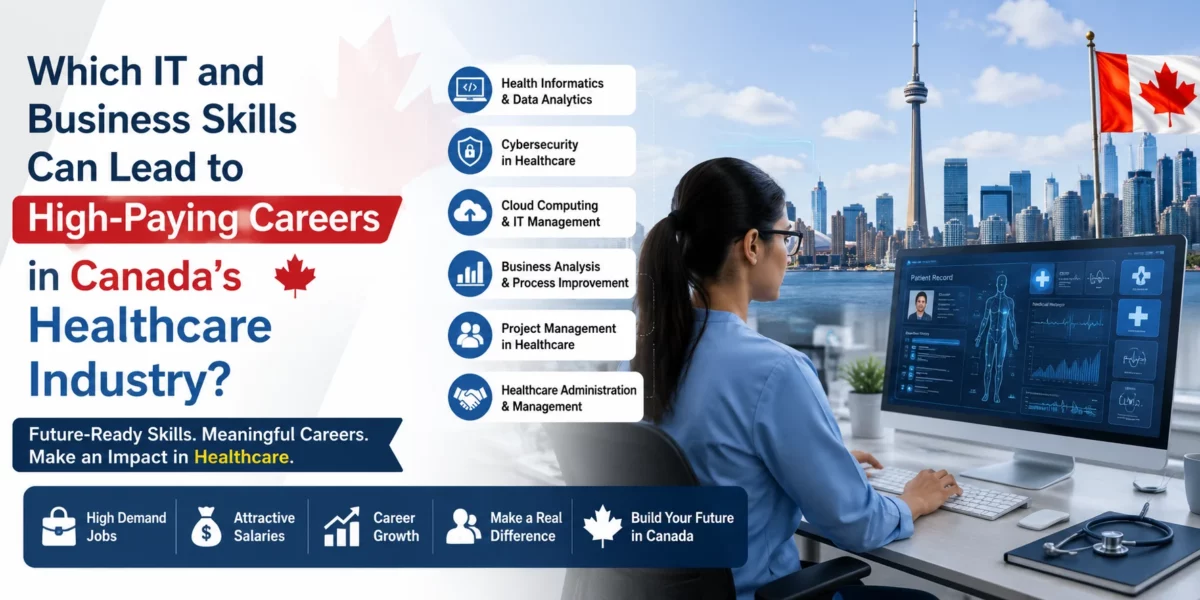
Introduction: Healthcare Careers in Canada
Healthcare is no longer supported only by doctors, nurses, personal support workers, and medical office staff. Modern healthcare increasingly depends on Information Technology, Artificial Intelligence, cloud computing, cybersecurity, data analytics, automation, electronic medical records, enterprise systems, supply chain management, and strong business administration.
Hospitals, clinics, long-term care homes, laboratories, pharmacies, community health organizations, and healthcare suppliers all rely on digital systems to deliver safer, faster, and more coordinated care. As healthcare becomes more technology-driven, new career opportunities are emerging for people who understand both healthcare operations and modern technology.
This raises an important question:
“Which IT and business skills can help students and professionals build rewarding careers in Canada’s healthcare industry?”
The answer is not limited to one skill or one diploma. The strongest opportunities are increasingly available to professionals who combine healthcare understanding with complementary skills in digital health, cloud platforms, cybersecurity, analytics, Artificial Intelligence, workflow automation, ERP systems, and business operations.
Why This Matters
Healthcare is one of the most essential sectors in Canada. At the same time, healthcare organizations face growing pressure to improve patient care, reduce delays, protect sensitive data, manage costs, support aging populations, and make better use of technology.
This creates demand for professionals who can help healthcare organizations use technology responsibly and effectively. The future of healthcare will require people who can connect clinical needs, administrative workflows, patient communication, data security, business operations, and modern IT infrastructure.
Choosing the right skill combination can lead to opportunities in healthcare IT, digital health administration, cloud support, cybersecurity, health data analytics, business analysis, ERP support, supply chain coordination, AI adoption, office administration, and technology-enabled healthcare operations.
“Healthcare is becoming one of Canada’s most important technology-supported sectors-not because technology replaces people, but because technology helps people deliver better care.”
How Healthcare Is Changing
Healthcare services are becoming more connected, data-driven, automated, and patient-focused. Many tasks that were once completed manually are now supported by digital systems, cloud applications, AI tools, mobile devices, and integrated enterprise platforms.
- Electronic Medical Records (EMR) and Electronic Health Records (EHR) help healthcare teams access patient information more efficiently.
- Cloud platforms support secure data storage, collaboration, research, reporting, and scalable healthcare applications.
- Edge AI enables faster decision-making closer to the patient, especially when immediate care decisions are required.
- Cybersecurity and application security protect patient data, healthcare applications, and connected medical systems.
- Business analytics helps healthcare leaders understand trends, costs, patient flow, staffing needs, and service quality.
- ERP systems support finance, procurement, inventory, human resources, and operational management in large healthcare organizations.
- Supply chain and logistics skills help ensure that medicines, equipment, protective supplies, and clinical materials are available when needed.
- Prompt engineering and Generative AI can help office, administrative, HR, marketing, training, and healthcare support workers improve productivity and communication.
High-Potential Career Areas in Healthcare Technology and Business
The following table provides examples of how different interests can connect to healthcare technology and business careers. These are examples rather than strict rules. Many professionals develop expertise in more than one area as healthcare technology evolves.
| If You Enjoy… | Consider Exploring… | What You’ll Typically Do |
| Helping healthcare teams use technology | Healthcare IT / Digital Health | Support healthcare applications, EMR systems, clinical workflows, user training, and technology-enabled patient care. |
| Analyzing healthcare data | Healthcare Data Analytics | Transform patient, operational, and business data into insights that support planning, quality improvement, and decision-making. |
| Protecting sensitive information | Cybersecurity & Application Security | Help protect patient data, healthcare applications, networks, identity systems, and connected medical devices. |
| Working with cloud platforms | Cloud Healthcare Infrastructure | Support secure cloud-based applications, analytics platforms, backup systems, and scalable healthcare services. |
| Improving operations | Healthcare Business Analysis | Identify workflow problems, document requirements, improve processes, and support digital transformation projects. |
| Using AI for productivity | Prompt Engineering & Generative AI | Use AI tools to support communication, documentation, research, training, reporting, marketing, and administration. |
| Managing supplies and resources | Healthcare Supply Chain & Logistics | Help manage medical supplies, procurement, inventory, vendor coordination, and operational continuity. |
| Supporting enterprise systems | ERP / SAP in Healthcare | Support finance, HR, procurement, inventory, reporting, and enterprise workflows used by healthcare organizations. |
| Automating work | Healthcare Workflow Automation | Use automation tools to reduce repetitive work, improve accuracy, and support faster administrative processes. |
| Supporting immediate care technology | Edge AI and IoMT | Work with real-time systems, sensors, devices, and analytics that support faster patient monitoring and response. |
Which IT and Business Skills Do Healthcare Employers Value?
Healthcare organizations increasingly need professionals who can understand technology, communicate clearly with users, protect sensitive information, improve processes, and support better patient outcomes. The most valuable skills often combine technical knowledge with healthcare awareness and business understanding.
Digital Health and Healthcare IT
- Electronic Medical Records and healthcare applications
- Clinical workflow understanding
- Healthcare documentation and data privacy awareness
- User support, training, and troubleshooting
- Digital transformation in hospitals, clinics, long-term care, and community care
Cloud Computing and Cloud Analytics
- Cloud infrastructure, storage, backup, and recovery
- Cloud-based healthcare applications
- Cloud analytics for research, reporting, and healthcare improvement
- Secure data pipelines and dashboards
- Scalable environments for healthcare data and AI projects
Cybersecurity and Application Security
- Patient data protection and privacy awareness
- Identity and access management
- Application security for healthcare portals and systems
- Security monitoring, incident response, and risk awareness
- Governance frameworks and compliance-oriented thinking
Artificial Intelligence, Prompt Engineering, and Generative AI
- Prompt engineering for office productivity
- AI-assisted research and summarization
- AI-supported documentation, training, and communication
- No-code workflow automation
- Responsible AI, bias awareness, privacy, and governance
Business, ERP, and Supply Chain Skills
- Healthcare business analysis
- ERP systems such as SAP or similar enterprise platforms
- Procurement, inventory, and vendor coordination
- Healthcare finance and administrative reporting
- Supply chain continuity for medicines, equipment, and clinical supplies
Automation, DevOps, and Governance Automation
- Automation of repetitive administrative and technical tasks
- DevOps concepts, CI/CD, and secure updates
- Governance automation for consistent policies and controls
- Infrastructure as Code concepts
- Reducing manual errors and improving operational consistency
Why Edge AI Matters for Immediate Patient Care
In healthcare, speed can matter. Edge AI refers to Artificial Intelligence that processes data closer to where it is generated, such as near medical devices, sensors, monitoring systems, or local healthcare environments. Instead of sending every piece of information to a distant cloud system first, some analysis can happen closer to the patient.
This can be important for patient monitoring, emergency alerts, remote care, wearable devices, medical imaging support, and situations where fast response is needed. Edge AI does not replace doctors or nurses. It supports healthcare teams by helping them receive timely information and identify changes more quickly.
Professionals who understand Edge AI, healthcare data, cybersecurity, and cloud connectivity may be well positioned for future roles in digital health, patient monitoring, connected care, and healthcare technology support.
Why Cloud Analytics Matters for Healthcare Research and Development
Healthcare research and development depends heavily on data. Cloud analytics enables organizations to collect, store, process, and analyze large volumes of healthcare information in scalable environments. This can support research, reporting, operational planning, quality improvement, and better decision-making.
Cloud analytics can help healthcare organizations study trends, patient outcomes, service demand, treatment patterns, staffing needs, and operational bottlenecks. When combined with AI and data governance, cloud analytics becomes a powerful tool for improving healthcare services and supporting evidence-informed decisions.
Students interested in healthcare careers should understand that data is becoming one of the most valuable resources in healthcare. The ability to manage and interpret data responsibly can create strong career opportunities.
Why Multi-Cloud Skills Matter for Redundancy and Reliability
Healthcare systems cannot afford long disruptions. Hospitals, clinics, laboratories, and healthcare suppliers depend on applications, data access, communication systems, and secure networks. Multi-cloud strategies can help organizations reduce dependence on one platform and improve resilience.
Multi-cloud does not simply mean using many cloud services. It means understanding how different cloud platforms can support redundancy, disaster recovery, scalability, security, and operational continuity. For healthcare organizations, this can be especially important when patient care depends on reliable access to systems and information.
Professionals with multi-cloud, networking, cybersecurity, automation, and governance knowledge can contribute to building healthcare systems that remain available, secure, and adaptable.
Why Application Security Matters for Patient Data Protection
Healthcare applications often contain highly sensitive information. Patient portals, appointment systems, EMR platforms, billing systems, laboratory applications, and mobile health tools must be designed, configured, and maintained securely.
Application security focuses on protecting software from vulnerabilities, unauthorized access, data leaks, and misuse. In healthcare, this is not only a technical concern; it is also an ethical and operational responsibility. A security weakness can affect patient trust, organizational reputation, and continuity of care.
Students who combine application security with healthcare awareness, cloud knowledge, identity management, and governance skills may find strong opportunities in secure digital health environments.
Why Cybersecurity and Governance Automation Are Essential
Cybersecurity protects healthcare systems from threats, while governance ensures that policies, standards, responsibilities, and controls are consistently applied. Governance automation helps organizations apply security rules, updates, compliance checks, and operational controls more consistently and efficiently.
In healthcare, seamless updates and secure operations are important because outdated systems and manual processes can create risk. Automation can help reduce human error, support patch management, enforce policies, and improve visibility across cloud, applications, networks, and enterprise systems.
Healthcare organizations need professionals who understand not only security tools but also governance, risk, compliance, automation, and business impact.
Why Prompt Engineering and Generative AI Matter for All Healthcare Workers
Generative AI is not only for programmers. Administrative staff, health office administrators, managers, HR staff, trainers, marketing teams, patient service staff, and business support professionals can use AI tools to improve productivity and communication.
Prompt engineering helps workers ask better questions, create clearer documents, summarize information, draft communications, plan training materials, prepare reports, support research, and automate repetitive office tasks. In healthcare environments, this must be done responsibly with attention to privacy, accuracy, ethics, and professional judgment.
AI should support people, not replace critical human care. Workers who understand how to use Generative AI responsibly can become more productive, adaptable, and valuable in modern healthcare organizations.
Why Modern Skills Matter for Health Office Administrators
Health office administrators increasingly work with digital systems, electronic records, scheduling platforms, billing tools, patient communication systems, reports, and privacy-sensitive information. Their role is no longer limited to traditional clerical tasks.
Modern health office administrators benefit from digital literacy, AI-assisted productivity, EMR awareness, cybersecurity awareness, communication skills, documentation skills, data handling, customer service, workflow improvement, and basic analytics. These skills can improve patient experience, office efficiency, and career growth.
A health office administrator who understands technology can contribute more effectively to a healthcare organization than someone who only performs routine administrative tasks.
Why ERP Systems Matter in Healthcare
Large healthcare organizations must manage finance, human resources, procurement, inventory, maintenance, reporting, compliance, and operational planning. Enterprise Resource Planning systems, including SAP and similar platforms, help organizations integrate these business functions.
ERP knowledge can be valuable in healthcare because hospitals and healthcare networks must control costs, manage supplies, coordinate departments, support workforce planning, and produce accurate reports. Professionals who understand ERP systems, business processes, data, and healthcare operations may support important administrative and operational roles.
ERP in healthcare is not only about software. It is about understanding how business functions support patient care.
Why Supply Chain and Logistics Are Critical in Healthcare
Healthcare supply chain is directly connected to patient care. Medicines, surgical supplies, protective equipment, diagnostic materials, devices, food services, maintenance parts, and emergency resources must be available when needed.
Supply chain disruptions can affect service quality, patient safety, cost control, and organizational readiness. Skills in procurement, logistics, inventory management, vendor coordination, data analysis, forecasting, and ERP systems can create valuable opportunities in healthcare operations.
Professionals who combine supply chain knowledge with analytics, AI, ERP, and healthcare awareness can support more resilient and efficient healthcare organizations.
Why Multiple Complementary Skills Matter
Healthcare technology careers increasingly reward people who can connect several areas of knowledge. A person who understands only one tool may perform a narrow task. A person who understands how technologies work together can help solve broader problems.
For example:
- Cloud Computing + Cybersecurity can help healthcare organizations build secure cloud environments.
- Edge AI + Healthcare Data + Patient Monitoring can support faster care decisions.
- Cloud Analytics + AI + Research can support healthcare improvement and innovation.
- Application Security + Identity Management + Governance can help protect patient data.
- ERP + Supply Chain + Business Analytics can improve procurement, inventory, and operational planning.
- Prompt Engineering + Generative AI + Office Administration can improve productivity for healthcare support staff.
- Linux + Automation + Multi-Cloud can support reliable infrastructure for healthcare applications.
- Cybersecurity + Governance Automation + Compliance Awareness can improve security operations and risk management.
“The future belongs to professionals who can connect healthcare knowledge, technology skills, business understanding, and responsible use of AI.”
Future Technologies Transforming Healthcare
Healthcare will continue to evolve as technology improves. Students and professionals do not need to master every technology immediately, but they should understand which areas are shaping the future.
- Artificial Intelligence and Machine Learning for decision support, pattern recognition, and workflow improvement.
- Generative AI for documentation, communication, research support, training, and administration.
- Edge AI for faster analysis near patients, devices, and care environments.
- Cloud analytics for research, reporting, and operational insights.
- Internet of Medical Things (IoMT), sensors, and wearable devices for remote monitoring.
- Cybersecurity, application security, identity management, and data protection.
- Multi-cloud and disaster recovery for resilience and continuity.
- Robotics, automation, and digital workflows for operational efficiency.
- ERP and supply chain analytics for healthcare operations and resource planning.
- Governance automation for secure, consistent, and compliant technology management.
Career Self-Assessment: Is Healthcare Technology Right for You?
Before choosing a healthcare technology or business pathway, reflect honestly on the following statements. There are no right or wrong answers.
- □ I am interested in healthcare but may not want to become a doctor or nurse.
- □ I enjoy using technology to solve practical problems.
- □ I am interested in improving patient care through better systems and processes.
- □ I enjoy organizing information, data, or workflows.
- □ I understand the importance of privacy and security in healthcare.
- □ I am willing to learn about AI, cloud, cybersecurity, analytics, or automation.
- □ I like helping teams work more efficiently.
- □ I am interested in long-term career growth in a stable and meaningful sector.
If several of these statements describe you, healthcare technology or healthcare business operations may be worth exploring. Genuine career counselling can help you decide which specialization best matches your interests and strengths.
From the Author’s Experience
I began my professional career as a Biological Sciences graduate, teaching Zoology, Chemistry, and Botany before transitioning into Information Technology in 1985. This background helped me understand that science, healthcare, education, and technology are not separate worlds. They increasingly support one another.
Over more than four decades in education, Information Technology, corporate training, business, human resources, enterprise systems including SAP, cloud computing, cybersecurity, automation, and Artificial Intelligence, I have seen how careers change when industries adopt new technologies. Healthcare is now entering one of the most important transformation periods of our time.
Students and professionals who understand both healthcare needs and technology can help organizations improve patient care, protect data, reduce delays, support research, manage resources, and improve operations. This is why healthcare technology, digital health, healthcare analytics, cybersecurity, AI, and business operations should be taken seriously by anyone planning a future-ready career.
Lesson Learned
Healthcare professionals who understand technology-and technology professionals who understand healthcare-will have some of the strongest career opportunities in the coming years.
Real-Life Career Story: When Healthcare Knowledge Meets Technology
Over the years, I have met many students and professionals who believed they had to choose between healthcare and technology. In reality, some of the strongest career opportunities appear when people combine both. A person with healthcare awareness who learns digital health systems, EMR workflows, data protection, and AI-assisted productivity can often contribute more effectively than someone who understands only administration or only technology. The same is true for IT professionals who learn healthcare operations, patient privacy, clinical workflows, and healthcare business processes.
Lesson Learned
Career growth often comes from combining what you already know with future-ready skills. Healthcare knowledge plus technology skills can create stronger opportunities than either area alone.
Real-Life Career Story: Why Administrative Workers Must Upgrade
Many office and administrative workers are now expected to use digital tools, prepare reports, communicate professionally, manage information, support customer or patient experience, and work faster with technology. In healthcare, this is even more important because accuracy, privacy, and communication directly affect service quality. Workers who learn AI productivity tools, prompt engineering, EMR awareness, cybersecurity awareness, and workflow automation can become more valuable to their organizations.
Lesson Learned
Modern healthcare administration requires more than clerical ability. Digital literacy, AI awareness, communication, privacy awareness, and workflow improvement are becoming essential skills.
Education Is a Long-Term Investment – Not Just a Short-Term Financial Decision
When choosing a diploma or training pathway, many students naturally consider tuition fees, program duration, location, and financial assistance. These are important factors, but they should not be the only factors.
A more important question is: Will this program help me build a career that remains valuable five, ten, or twenty years from now?
In healthcare technology and healthcare business careers, the strongest programs should help students understand practical skills, future technologies, employer expectations, security responsibilities, digital transformation, and the importance of continuous learning.
“Choose your education based on where it can take you over the next 30 years-not simply on what makes it easiest to begin today.”
Who Can Help You Decide?
Healthcare technology includes many possible pathways. Some students may be suited to Healthcare IT, others to digital health administration, cloud support, cybersecurity, data analytics, ERP, supply chain, AI productivity, or business analysis. The best choice depends on the individual.
A knowledgeable career counsellor should first understand your interests, strengths, background, learning style, and long-term career goals. They should also understand how healthcare, technology, business operations, and Artificial Intelligence are evolving.
Good career counselling should not simply recommend the next available program. It should help you understand your options and choose a pathway that can support long-term career growth.
Career Decision Framework
Career Interest
↓
Area of Study
↓
Healthcare Technology or Business Specialization
↓
Skills Required
↓
Career Counselling
↓
Compare Diplomas
↓
Choose College
↓
Develop Multiple Skills
↓
Continuous Learning
↓
Career Growth
Career Perspective
Healthcare careers are changing. Technology is becoming part of patient care, administration, research, operations, supply chain, finance, security, and communication. For this reason, students should not think only about their first job. They should think about how their skills can grow as healthcare continues to modernize.
The best career decisions are usually based on a balance of interest, ability, employer demand, future technologies, and willingness to continue learning.
The Bottom Line
Canada’s healthcare industry needs more than clinical professionals. It also needs people who can support digital systems, secure data, analyze information, improve workflows, manage operations, use AI responsibly, support supply chains, and help organizations adapt to new technologies.
High-paying and rewarding healthcare-related careers may be available to those who combine IT, business, healthcare awareness, AI, cloud computing, cybersecurity, analytics, ERP, automation, and communication skills.
The goal is not simply to find a job in healthcare. The goal is to build a future-ready career that supports better healthcare services while creating long-term professional growth.
Before You Decide
Before choosing a healthcare technology, IT, or business pathway, ask yourself:
- Am I interested in healthcare, technology, business operations, or a combination of these areas?
- Do I understand how AI, cloud computing, cybersecurity, and analytics are changing healthcare?
- Have I considered both my first job and long-term career growth?
- Am I prepared to continue learning as healthcare technologies evolve?
- Have I spoken with a knowledgeable career counsellor before choosing a program?
- Will the skills I learn remain valuable as healthcare becomes more digital, automated, and data-driven?
The decisions you make before enrolling can influence your career, earnings, professional growth, and job satisfaction for many years to come.
“Choose your profession wisely. Choose your education carefully. Continue learning throughout your career.”
Need Career Guidance?
If you are considering a career that combines healthcare, IT, business, AI, cloud, cybersecurity, analytics, ERP, or supply chain skills, speak with an experienced career counsellor who understands both education and industry. A thoughtful discussion about your interests, strengths, background, and long-term goals can help you choose a pathway before investing your time, effort, and money.
About the Author
The author has more than four decades of experience in education, business, human resources, corporate training, Information Technology, enterprise systems including SAP, cloud computing, cybersecurity, automation, and Artificial Intelligence. Having transitioned from a Biological Sciences background into IT in 1985, he has continually adapted to emerging technologies while helping individuals and organizations prepare for the future.
Throughout his career, he has held leadership and professional roles in both industry and education, including serving as an airline station manager, working as an IT consultant with the Government of Canada across several federal departments, delivering technical training to personnel from National Defence Canada, and leading educational institutions in Canada for more than 24 years and internationally for five years.
Drawing on this diverse experience, he is passionate about helping students and professionals make informed career decisions, develop future-ready skills, and prepare for the technologies, careers, and workplace demands of tomorrow.
Frequently Asked Questions
Yes. Healthcare organizations depend on IT systems, networks, cloud platforms, cybersecurity, EMR applications, analytics, and digital health tools. Professionals who understand technology and healthcare operations can support many important roles.
Yes. Healthcare organizations need business professionals in administration, operations, finance, HR, supply chain, procurement, project coordination, analytics, and process improvement. Business skills become even more valuable when combined with technology and healthcare awareness.
Useful skills include EMR awareness, cloud computing, cybersecurity, application support, data analytics, networking, Linux, automation, privacy awareness, and user support. The best skill combination depends on your career goal.
Edge AI can process information closer to patients, devices, or care environments. This may support faster alerts, monitoring, and decision support in situations where time matters. It does not replace healthcare professionals; it supports timely information and care coordination.
Cloud analytics helps healthcare organizations store, process, and analyze large volumes of data. This can support research, reporting, service improvement, operational planning, and better decision-making.
Multi-cloud knowledge can support redundancy, disaster recovery, scalability, and resilience. Healthcare organizations need reliable systems because delays or outages can affect service quality and patient care.
Absolutely. Healthcare organizations handle sensitive patient information and rely on connected systems. Cybersecurity, application security, identity management, and governance are essential for protecting data and maintaining trust.
Generative AI can help with communication, documentation, research, summarization, training materials, office productivity, and workflow support. It must be used responsibly with attention to privacy, accuracy, ethics, and professional judgment.
Yes. Modern health office administrators benefit from digital literacy, EMR awareness, AI productivity tools, cybersecurity awareness, communication skills, data handling, scheduling systems, and workflow improvement.
Yes. Large healthcare organizations use enterprise systems to support finance, HR, procurement, inventory, reporting, and operations. ERP knowledge can be valuable for healthcare business and administrative roles.
Healthcare supply chain helps ensure that medicines, equipment, protective supplies, and clinical materials are available when needed. Strong supply chain and logistics skills support patient care, cost control, and operational continuity.
Not always. Some roles focus on support, administration, cloud operations, analytics, cybersecurity awareness, business analysis, or digital health workflows. However, basic scripting, automation, or data skills can become an advantage over time.
Yes. Healthcare workers who add skills in digital health, communication, documentation, AI productivity, healthcare administration, data awareness, or technology support may open new career pathways. The right path depends on their interests, experience, and goals.
Yes. Newcomers with healthcare, IT, business, administration, engineering, or science backgrounds may be able to build careers by adding Canadian workplace knowledge, digital health awareness, technical skills, communication, and career guidance.
Do not choose based only on salary or popularity. Choose a pathway that matches your interests and strengths, has strong future demand, and allows you to keep learning as healthcare and technology evolve.