

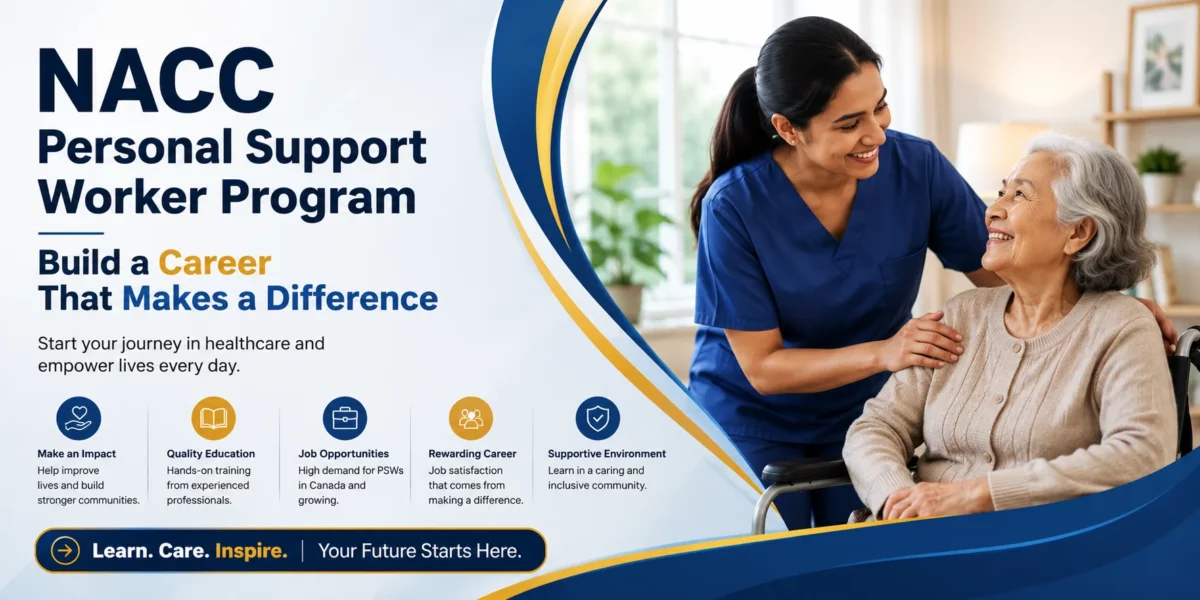
Why Personal Support Workers Are More Important Than Ever
Helping People. Supporting Families. Building Communities.
Canada’s population is aging – and the need for compassionate, skilled caregivers has never been greater. More seniors are choosing to stay in their homes longer. Healthcare facilities continue to face staffing shortages. And families across Ontario are increasingly looking for qualified support to help aging parents, loved ones recovering from illness, and individuals who need daily care.
In the middle of all this stands one of the most important roles in Canada’s healthcare system: the Personal Support Worker.
PSWs are not just healthcare workers. They are the people who show up every day – in homes, hospitals, long-term care facilities, and community settings – to make sure that real people are supported, respected, and cared for. As the demand for this type of care continues to grow, so does the opportunity for individuals who want to build a career with genuine purpose.
A Career That Makes a Difference Every Day
Most jobs involve completing tasks. A PSW career involves changing lives.
Personal Support Workers help clients maintain what matters most to them:
- Independence – supporting people in doing things their own way, on their own terms
- Dignity – treating every client with the respect and care they deserve
- Comfort – ensuring clients feel physically and emotionally at ease in their environment
- Safety – reducing risks and responding quickly when situations change
- Quality of Life – helping people live fuller, more connected lives despite health challenges
Whether working in a long-term care facility, a retirement residence, a hospital, a community organization, or a private home, PSWs play a critical role not just for their clients – but for the families who love them and the communities they belong to.
This is not a desk job. It is not a role where days blur together in routine. It is work that puts you face to face with real people going through real challenges, and it gives you the ability to make those challenges more manageable – every single day.
Strong Demand Across Ontario
The job market for Personal Support Workers in Ontario is not just good right now – it is expected to remain strong for years to come.
The demand for qualified PSWs continues to grow because of several overlapping factors:
- Canada’s aging population – the baby boomer generation is moving into its senior years, and the healthcare needs of this group are large and growing
- Increased healthcare needs – chronic conditions, longer life expectancy, and complex care requirements are driving demand for support services
- Expansion of home and community care – more services are being delivered outside hospitals and institutions, directly in people’s homes and communities
- Growth in retirement living communities – the retirement residence sector is expanding rapidly across Ontario, creating new positions for PSWs
- Workforce shortages in healthcare support – there are more open positions than there are qualified candidates, meaning graduates often find employment relatively quickly
Many employers in Ontario are actively looking for qualified PSWs who combine technical training with genuine compassionate care abilities. That combination is exactly what a strong PSW program is designed to build.
What Students Learn in the NACC PSW Program
The NACC Personal Support Worker program provides hands-on, practical training that prepares graduates for real workplace environments. The curriculum covers everything a PSW needs to begin working confidently and competently in a healthcare or community care setting.
Personal Care Support
Day-to-day client care is at the heart of what PSWs do. This module covers:
- Assisting with activities of daily living – dressing, eating, bathing, and grooming
- Personal hygiene support for clients who need assistance maintaining cleanliness and comfort
- Mobility assistance – helping clients move safely within their environment
- Safe lifting and transferring techniques to protect both clients and PSWs from injury
Health and Safety
Healthcare environments carry specific risks that PSWs need to understand and manage. Training includes:
- Infection prevention and control – reducing the spread of illness in care settings
- Workplace health and safety – understanding rights, responsibilities, and risk management
- Client safety procedures – recognizing hazards and responding appropriately
- Emergency response awareness – knowing what to do when unexpected situations arise
Communication Skills
Effective communication is one of the most important skills a PSW can develop. Students learn:
- Professional communication – how to interact clearly and respectfully with supervisors and colleagues
- Family interaction – supporting the loved ones of clients with empathy and clarity
- Client-centered care – keeping the client’s preferences, values, and needs at the center of every interaction
- Documentation and reporting – accurately recording observations and care activities to support the broader healthcare team
Community and Home Care
PSWs work in a wide range of environments, not just hospital wards. This area of training covers:
- Supporting clients in community settings – navigating care delivery outside traditional facilities
- Home care environments – understanding the unique dynamics of providing care in someone’s personal space
- Retirement residences – working within residential communities for older adults
- Long-term care facilities – operating within structured care environments with diverse client needs
Special Care Needs
Many PSW clients have conditions that require additional knowledge and sensitivity. Training in this area includes:
- Dementia awareness – understanding how dementia affects behavior, communication, and daily functioning
- Cognitive support strategies – practical techniques for working effectively with clients experiencing cognitive decline
- Palliative care support – providing compassionate care for clients approaching end of life
- Mental health awareness – recognizing and responding thoughtfully to clients living with mental health challenges
More Than Technical Skills
Completing a PSW program gives you the technical foundation you need. But the PSWs who truly stand out – and who employers most want to hire – are those who bring more than just training to the job.
Employers across Ontario increasingly look for PSW candidates who demonstrate:
- Compassion – genuine care for clients as full human beings, not just as tasks to complete
- Patience – the ability to stay calm, consistent, and supportive even in difficult moments
- Professionalism – showing up reliably, communicating clearly, and representing their organization well
- Reliability – being someone that clients, families, and employers can count on
- Communication skills – listening well, speaking clearly, and documenting accurately
- Teamwork – working collaboratively with nurses, doctors, coordinators, and other care team members
These qualities are not just nice to have. In many cases, they are the difference between a PSW who advances quickly and one who struggles to find their footing. A good PSW program will help you develop not just knowledge, but these professional qualities as well.
Career Opportunities After Graduation
One of the most appealing aspects of the PSW profession is its range of employment options. Graduates may pursue positions in:
- Long-Term Care Homes – providing daily care and support to residents in regulated care environments
- Retirement Residences – supporting older adults who want independent or assisted living with on-site support
- Home Care Agencies – working directly in clients’ homes, often in one-on-one care arrangements
- Community Support Organizations – delivering care through community programs, outreach services, and non-profit organizations
- Assisted Living Facilities – supporting individuals with disabilities or complex needs in supported housing
- Hospitals – working alongside clinical staff to support patient care in medical settings
- Private Care Settings – providing personalized care arrangements directly for families and individuals
This flexibility is a significant advantage of the PSW credential. You are not locked into one type of workplace. As your experience grows, you can explore different settings, find the environment that suits you best, and even specialize in areas like dementia care, palliative support, or community health.
Typical Ontario Salary Range
A PSW career is not only rewarding – it can also be financially stable, with room to grow over time.
Entry-Level Positions:
- $40,000 – $55,000+ per year
Experienced Personal Support Workers:
- $55,000 – $75,000+ per year
Beyond the base salary, many PSWs have access to additional earnings through:
- Shift premiums for evening, overnight, and holiday work
- Weekend work that often comes with higher pay rates
- Overtime opportunities in facilities dealing with staffing gaps
- Specialized care environments that compensate for additional expertise or certifications
As Ontario continues to invest in healthcare and community care infrastructure, compensation for PSWs has been trending upward. For many graduates, this role offers a clear path to financial stability alongside meaningful work.
A Career with Purpose
Many careers offer a paycheck. Very few offer the chance to genuinely improve someone’s quality of life – not once, but every single day.
Personal Support Workers often become trusted, familiar presences in their clients’ lives. For an elderly person living alone, a PSW might be one of the few faces they see regularly. For a family managing a loved one’s illness from a distance, a PSW is the person they trust to show up and do things right. For a client recovering from surgery, a PSW is part of the reason they can heal at home instead of in a facility.
That kind of impact is rare in any career. And it does not go unnoticed – by clients, by families, or by healthcare employers who know how much good PSWs are worth.
Why Choose Canadian College for Higher Studies?
With so many training options available, the institution you choose matters. Canadian College for Higher Studies has built a reputation for educational quality, student support, and practical career preparation over more than 37 years.
Here is what sets CCHS apart:
- Over 37 Years of Educational Leadership – a long track record of preparing students for real careers in healthcare, business, and technology
- Industry-Focused Programs – curricula designed around what employers actually need, not outdated textbook theory
- Experienced Instructors – faculty who bring decades of practical experience from healthcare, education, technology, and workforce development
- Career Support Services – guidance that goes beyond the classroom and extends into job search, professional development, and employability coaching
- Modern Learning for Today’s Workplace – training that reflects how healthcare and care environments actually operate today
- Flexible Learning Options – scheduling that accommodates working adults, caregivers, and individuals managing other commitments
- Commitment to Student Success – a student-centered culture where support is available from admissions through graduation and beyond
The goal at CCHS is not simply to help students graduate. It is to help students develop practical skills, professional confidence, and the career readiness that employers genuinely value. Thousands of students and professionals have built successful careers after training with the CCHS management team – across healthcare, business, information technology, government, and private industry.
Funding Opportunities May Be Available
Cost should not be a barrier to building a career in healthcare. Eligible individuals may be able to access financial support through programs such as:
- Better Jobs Ontario (BJO) – a provincial program that helps unemployed or at-risk workers access training in high-demand occupations
- Workforce Development Programs – regional and provincial programs designed to support career transitions and skills development
- Employment Assistance Programs – support available through employment services organizations and community agencies
If cost is a concern, it is worth exploring these options before assuming training is out of reach. An advisor at CCHS can help you understand what funding may be available and how to apply.
The Future Needs More Caregivers
Technology will continue to reshape how healthcare is delivered. Artificial Intelligence can assist with monitoring, reporting, and pattern recognition. Digital systems can improve efficiency and communication across care teams. These tools will play an important role in the future of healthcare.
But technology cannot hold someone’s hand. It cannot sit with a client who is scared or confused. It cannot notice that a person’s mood has changed and take the time to ask why. Compassion, empathy, human presence, and personal care are not things that can be automated – and they never will be.
The need for qualified Personal Support Workers is not going away. If anything, it is growing. The future of healthcare depends on people who are willing to show up, do the work, and care – genuinely and consistently – for the people who need it most.
Help Others Live Better. Build a Career with Purpose. Become a Personal Support Worker.
Frequently Asked Questions
A PSW assists clients with daily activities like bathing, dressing, mobility, and meal support. They also document observations, communicate with care teams, and provide emotional support – adapting to each client’s unique needs and routines throughout the day.
PSW programs vary in length, but most diploma programs can be completed in several months of full-time study. Part-time and flexible options may be available for students balancing work or other commitments. Contact the admissions team for current program schedules.
Yes. Ontario continues to experience significant demand for qualified PSWs due to an aging population, healthcare staffing shortages, and growth in home and community care. Many graduates find employment relatively quickly after completing their training.
Most PSW programs do not require previous healthcare experience. If you have a genuine desire to help others and meet the basic admission requirements, you are generally eligible to apply and begin training.
Entry-level PSWs in Ontario typically earn between $40,000 and $55,000 per year. With experience, earnings can reach $55,000 to $75,000 or more, with additional income available through shift premiums, weekend work, and overtime in high-demand settings.
Eligible learners may qualify for funding through programs like Better Jobs Ontario (BJO), Workforce Development Programs, or Employment Assistance Programs. These programs are designed to help individuals access training in high-demand fields. An admissions advisor at Canadian College for Higher Studies can help you explore your options.