

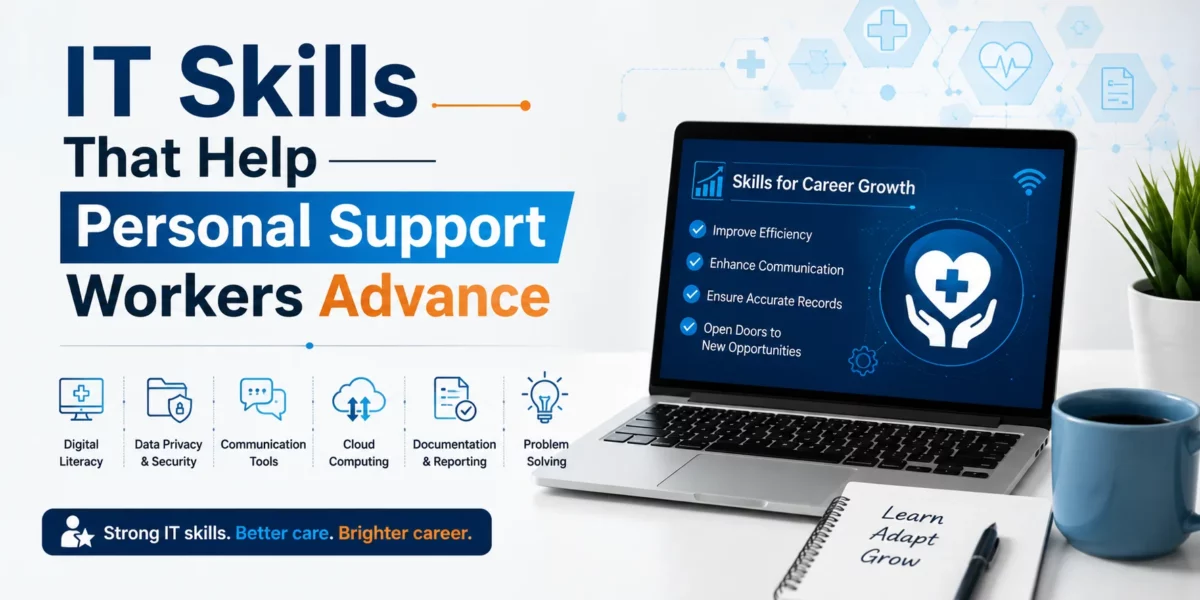
What IT Skills Can Help a Personal Support Workers (PSW) Advance Their Career?
Many people enter the Personal Support Workers (PSW) profession because they genuinely want to help others. The work is deeply human – supporting clients with daily activities, offering companionship, and making a real difference in someone’s quality of life. But the healthcare world around PSWs is changing fast.
Today’s care environments run on technology. From the way patient records are stored to how care teams communicate across shifts, digital tools have become a core part of how healthcare gets delivered. PSWs who take the time to build even a basic level of technology confidence are finding that it opens doors – to better workplace performance, more responsibility, and long-term career advancement.
This blog walks through the IT skills that are most relevant for PSWs today, explains why they matter, and shows how building these skills can create real opportunities.
Why Technology Skills Are Becoming Essential in Healthcare
Healthcare organizations across Canada are under increasing pressure. They need to:
- Improve patient outcomes and quality of care
- Manage growing workloads with limited staff
- Reduce administrative errors and documentation gaps
- Support a rapidly aging population
- Improve communication across care teams
Technology is one of the main tools being used to meet these demands.
Think about what has changed in the past decade alone. Paper-based records have largely been replaced by digital systems. Scheduling is done through workforce management software. Communication between care teams happens through secure digital platforms. And now, AI-powered tools are beginning to assist with monitoring, risk prediction, and documentation.
For PSWs, this shift means one thing: technology is no longer optional knowledge. It is part of the job. PSWs who understand how digital systems work – even at a basic level – tend to adapt more easily to modern healthcare workplaces, communicate more effectively with their care teams, and take on greater responsibilities over time.
Electronic Medical Records (EMR)
If there is one technology skill that has the most direct impact on day-to-day PSW work, it is comfort with Electronic Medical Records.
EMR systems are used across healthcare settings to manage patient information digitally. Common use cases include:
- Recording patient information and medical history
- Tracking daily care activities and completed tasks
- Documenting observations like changes in behavior or physical condition
- Improving communication between nurses, doctors, and support staff
When a PSW logs a client’s meals, notes a change in behavior, or records a care task completed during a shift, that information goes into the EMR – and it is used by nurses, doctors, and other professionals to make care decisions.
PSWs who understand how to navigate these systems do more than just enter data. They contribute meaningfully to continuity of care. Accurate, timely documentation means the next care provider has what they need. It reduces the risk of errors. And it helps supervisors and healthcare teams spot patterns that might otherwise go unnoticed.
Some of the most commonly used EMR systems in Canadian healthcare settings include Point Click Care, AccuMed, and various provincial digital health platforms. Familiarity with any of these – or even just comfort with digital data entry in general – gives PSWs a clear advantage in the workplace.
Microsoft Office and Digital Productivity Tools
Basic computer literacy might sound like a given, but many PSWs enter the profession without formal training in digital productivity tools – and it shows in the workplace.
Some of the most commonly used tools in healthcare workplaces include:
- Microsoft Word – writing reports, care notes, and formal communication
- Microsoft Excel – tracking schedules, data entry, and simple reporting
- Microsoft Outlook – managing professional emails and calendars
- Microsoft Teams – virtual meetings, team chats, and document sharing
- Google Workspace (Docs, Sheets, Gmail, Meet) – used in organizations that prefer Google’s ecosystem
These tools are used daily for communication, reporting, scheduling, and documentation.
For PSWs, knowing how to write a clear email in Outlook, update a shared schedule in Excel, or join a virtual care team meeting in Teams is not just a convenience. It is a professional skill that affects how you are perceived and how effectively you can do your job.
These tools also matter for career growth. When supervisors look for candidates to take on coordinator roles or administrative responsibilities, they want someone who can handle digital communication confidently. A PSW who can do that is already a step ahead.
Digital Health Technologies
Healthcare is increasingly delivered through digital channels, and PSWs are on the front lines of that shift.
Here are some of the most common digital health technologies PSWs may encounter:
- Telehealth systems – virtual appointments where PSWs may help clients set up devices or join video calls with their physicians
- Remote patient monitoring – wearable sensors that track heart rate, blood oxygen, and sleep patterns between in-person visits
- Mobile health apps – tools for tracking medications, symptoms, and upcoming appointments
- Smart healthcare devices – automated medication dispensers and fall-detection wearables used in home care and residential settings
PSWs do not need to be tech support specialists. But understanding how these tools work – and being comfortable helping clients use them – makes a meaningful difference in the quality of care delivered and in the PSW’s value to their employer.
AI Awareness in Healthcare
Artificial Intelligence is already being used in healthcare, and its presence will only grow. For PSWs, this does not mean needing to understand algorithms or machine learning. It means understanding how AI-powered tools show up in everyday care environments – and being comfortable working alongside them.
Some practical examples of AI in healthcare today include:
Fall detection systems – AI-enabled cameras and wearable sensors that can detect when a client falls and automatically alert caregivers or emergency services.
Patient monitoring technologies – Systems that analyze vital sign data in real time and flag abnormalities, reducing the need for manual checks.
Medication management systems – Automated dispensers and reminder apps that help clients take the right medications at the right time, reducing errors.
Risk prediction tools – Software that analyzes health records to identify clients at higher risk of hospitalization, allowing care teams to act proactively.
Healthcare analytics dashboards – Tools that give organizations a high-level view of service delivery, quality metrics, and population health trends.
PSWs who understand what these systems do – and why their organization uses them – are better positioned to work within modern care environments. They can explain tools to clients, notice when something seems off with a monitoring device, and contribute meaningfully to conversations about patient care.
Healthcare Documentation and Accurate Reporting
One of the most critical responsibilities of any PSW is documentation. What gets recorded shapes everything from care plans to staffing decisions to billing. Poor documentation – whether incomplete, inaccurate, or late – creates risk for clients and liability for organizations.
Technology skills directly support better documentation habits. PSWs who are comfortable with digital tools tend to:
- Document observations and care activities more promptly
- Use structured templates and forms correctly
- Catch and correct errors before submission
- Communicate more clearly with colleagues and supervisors
Healthcare organizations rely on these records not just for individual client care, but for quality audits, accreditation requirements, and funding decisions. A PSW who takes documentation seriously – and has the tech skills to do it well – is genuinely valuable.
Data Privacy and Cybersecurity Awareness
Healthcare information is among the most sensitive data in existence. Patient records, personal details, medication histories, and mental health information all fall under strict privacy laws in Canada, including provincial privacy legislation and PIPEDA.
Every healthcare professional – regardless of role – has a responsibility to understand the basics of data privacy and cybersecurity. For PSWs, this means knowing:
- Why patient information must be kept confidential
- How to handle sensitive information on shared devices
- What phishing emails look like and how to avoid them
- Why strong, unique passwords matter
- How to report potential privacy breaches to supervisors
Cybersecurity is increasingly a priority for healthcare organizations. A single employee clicking on a malicious link can compromise thousands of patient records. Healthcare organizations value staff who take privacy seriously and know how to behave safely in digital environments.
Scheduling and Workforce Management Systems
Modern healthcare organizations do not manage staff scheduling on paper or simple spreadsheets. They use dedicated workforce management platforms that handle:
- Shift assignments and coverage planning
- Attendance tracking and time records
- Availability submissions and scheduling conflicts
- Workforce planning across multiple locations or teams
For PSWs, being comfortable with these systems is increasingly a baseline expectation. Logging into a scheduling app to check a shift, submitting an availability update, or confirming a schedule change through a digital portal are all routine tasks in many organizations. PSWs who are not comfortable with these tools can find themselves dependent on supervisors for basic administrative tasks – which creates friction and limits career growth.
Healthcare Analytics Awareness
This one is less about daily tasks and more about professional development and career readiness. Healthcare organizations are increasingly data-driven. Quality of care metrics, service delivery numbers, staffing ratios, client satisfaction scores – organizations track all of this to make decisions about resources, programs, and priorities.
PSWs do not need to become data analysts. But understanding why data matters in healthcare, and what terms like “outcome metrics” or “service utilization rates” refer to, helps PSWs participate more meaningfully in team conversations and understand the bigger picture of their organization’s goals.
It also helps when pursuing career advancement. Coordinator and administrative roles increasingly require familiarity with data reporting, and even a basic understanding of healthcare analytics puts candidates ahead of those with no exposure at all.
IT Skills That Can Open New Career Doors
As PSWs build experience and layer in technology skills, new career paths become accessible. Some of the roles that PSWs with strong digital skills often move into include:
- Care Coordinator – Managing care plans, schedules, and communication across a team of PSWs
- Healthcare Administrator – Supporting operations in a clinical or residential care setting
- Medical Office Professional – Working in a physician’s office or clinic environment
- Client Service Coordinator – Serving as a point of contact for clients and families
- Retirement Residence Supervisor – Overseeing PSW teams in a residential setting
- Community Services Coordinator – Coordinating community-based programs and supports
- Healthcare Technology Support Roles – Helping organizations implement and maintain digital health tools
- Digital Health Support Positions – Supporting staff and clients in using telehealth and health apps
What makes this combination particularly powerful is that PSWs already have something that is very hard to teach: genuine care for people. Technical skills can be learned. Compassion cannot. Healthcare organizations increasingly value professionals who bring both.
How to Start Building These Skills
If you are a PSW looking to strengthen your technology skills, you do not need to overhaul your entire skill set overnight. Some good starting points include:
- Getting comfortable with the EMR system your workplace uses
- Taking a free Microsoft Office tutorial on YouTube or LinkedIn Learning
- Reviewing your organization’s data privacy and cybersecurity policies
- Exploring your workplace’s scheduling app or workforce management tool
- Asking a supervisor or colleague to walk you through any unfamiliar digital systems
From there, you can explore more structured training options. Canadian College for Higher Studies offers programs specifically designed to help healthcare professionals build skills in areas like digital health technologies, AI awareness, cloud data analytics, office administration technologies, and business productivity tools. These programs are built with working professionals in mind and can complement existing healthcare experience without requiring a full-time commitment.
The Future of PSW Work Is Both Human and Digital
Technology will continue to change how healthcare is delivered. AI may assist with monitoring. Digital platforms may improve how care teams communicate. Analytics may help organizations identify clients who need more support before a crisis develops.
But here is what will not change: healthcare will always be fundamentally human. No algorithm can replace the presence of a compassionate person at a client’s bedside. No app can provide the kind of comfort that comes from a familiar, trusted face.
The most successful PSWs of the future will be those who bring both sides to the table – the warmth and empathy that defines great care, and the digital confidence to work effectively in a technology-driven environment.
Care for people. Understand technology. Create more career opportunities.
Frequently Asked Questions
You do not need to be a technology expert, but basic digital confidence is increasingly expected. Understanding EMR systems, scheduling software, and communication tools helps PSWs perform better and qualify for more advanced roles over time.
Electronic Medical Records (EMR) is the most immediately useful skill. Most healthcare facilities use digital documentation systems, and comfort with EMR directly improves how effectively you can contribute to patient care and team communication.
Understanding how AI-powered tools like fall detection systems or medication reminders work helps PSWs use them correctly and support clients more effectively. It also signals to employers that you are prepared for modern, technology-integrated care environments.
Absolutely. PSWs handle sensitive patient information daily. Knowing how to protect that data – through safe password practices, recognizing phishing attempts, and following privacy protocols – is a professional and legal responsibility in Canadian healthcare.
Yes. Roles like Care Coordinator, Client Service Coordinator, and Healthcare Administrator typically offer higher pay than frontline PSW positions. These roles often require digital literacy, documentation skills, and familiarity with healthcare systems – all skills a PSW can develop with focused effort.
Several colleges offer relevant programs. Canadian College for Higher Studies provides training in digital health technologies, AI awareness, office administration, and healthcare analytics – designed to complement your existing experience and prepare you for the evolving healthcare workplace.
Latest Post
- What Is Agentic AI? Skills, Careers & Future Job Opportunities
- Best Courses to Get a Job in Canada After Graduation
- AI, IoT and Edge Computing: How These Technologies Work Together
- AI-Powered Cyber Attacks: What Students & Businesses Must Know
- What Is Healthcare Administration and Is It Good in Canada?