

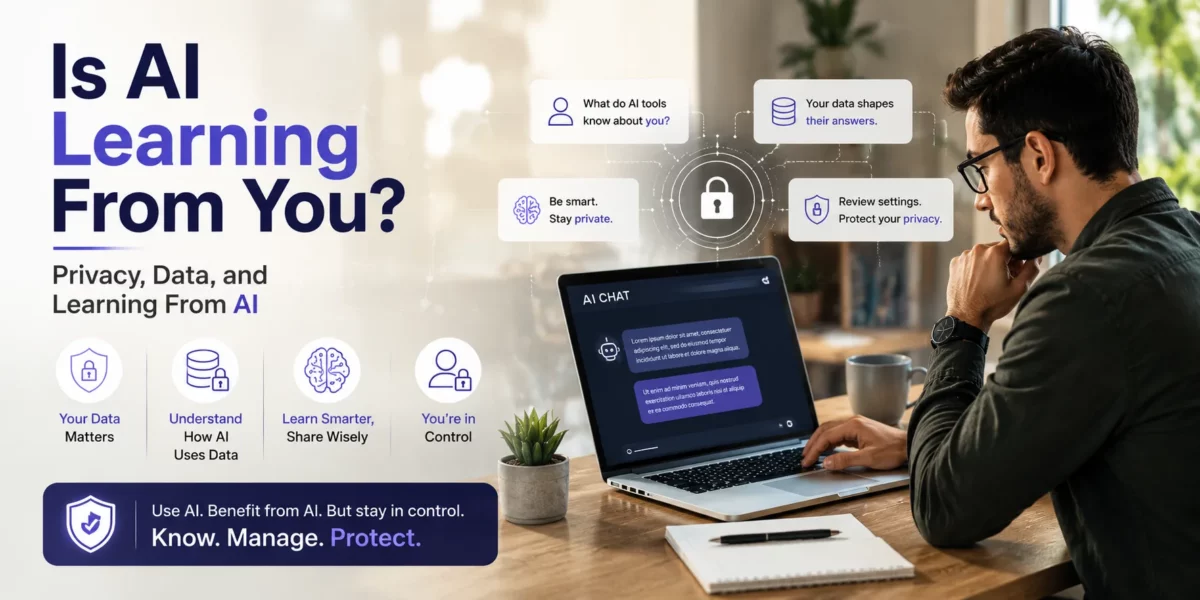
Is AI Learning From You? And What Are You Learning From AI?
Every time you open a chatbot, run a search, or ask an AI tool to help you write something, two things are happening at once. You are getting help. And somewhere in the background, data is being collected. That second part makes a lot of people uncomfortable. Which is why one of the most common questions I get goes something like this:
“Is AI learning from me every time I use it?”
And right after that:
“Am I basically helping these companies build a better product for free?”
Both are fair questions. The honest answer to both is: it depends. But if you stop there, you are missing the more important question. Let me explain what I mean.
Every Major Technology Revolution Has Used Its Users
This is not a new pattern. Every major technology leap in history got better because real people used it in the real world. That feedback, whether it came through complaints, usage data, or plain common sense, shaped what the technology became.
The Automobile
Early cars were unreliable machines that broke down constantly and required expert knowledge to operate. They got better not because engineers sat in a lab guessing what drivers needed. They got better because millions of people drove them, and manufacturers learned from what kept breaking, where accidents happened, what roads demanded, and what customers kept asking for.
The feedback loop between user and product made cars dramatically safer, more efficient, and far easier to use over a span of decades.
The Personal Computer
Software improved for the same reason. When businesses started putting computers on desks in the 1980s, most software was clunky, confusing, and written by engineers for other engineers. Users broke things constantly. They found bugs developers never anticipated. They had requirements that no one had written down. They pushed back on interfaces that made no sense to them.
That friction, that constant gap between what software did and what users actually needed, is what drove the improvement cycles that eventually gave us the software most of us take for granted today.
The Internet and Search Engines
Search engines did not get smart by themselves. They got smarter because billions of people searched for things. Every search told the engine something: what people were looking for, whether the results they clicked on actually answered the question, what made them leave immediately versus stay and read. That behaviour data, collected at massive scale over years, is what made modern search so much more accurate than the early versions.
AI is following the same pattern. And understanding that pattern is important, because it helps you make sense of what is actually happening when you interact with AI systems today.
So Does AI Actually Learn From Your Interactions?
Here is where people often get confused, because the word “AI” covers a very wide range of different systems that work in very different ways.
AI Systems That Adapt Continuously
Some AI systems do adjust their behaviour based on user interactions in real time. The most familiar examples are recommendation engines. When you watch something on a streaming platform and the app suggests something similar next time, that is AI adapting based on what you did. When an online shopping site learns which products to show you based on your browsing history, that is the same principle at work.
Navigation apps do this too. When many drivers take an unexpected detour around a particular road, the app learns that something is wrong with that route and adjusts future recommendations. No engineer made that decision. The pattern emerged from what users actually did.
AI Systems That Do Not Learn In Real Time
Large language models, the kind behind most AI chatbots, work differently. When you type a question into an AI assistant and get a response, that single conversation does not automatically update the model. The model was trained on a fixed dataset over a defined period, and that training is not happening live as you chat.
However, the company running the system may collect those conversations and use them later. That data can be used to identify where the model gives wrong answers, where it misunderstands requests, where users give up in frustration, and where the system performs well. That information feeds into future training rounds, which improve the next version of the model.
So the honest answer is: your interactions may not be teaching the AI right now, but they may well be shaping what the AI becomes over the next year or two.
What Happens to Your Data?
This is a practical question and it deserves a practical answer.
Different platforms handle data in different ways. Some AI providers are explicit that they use user interactions to improve their models. Others offer opt-out settings that allow you to use the tool without your conversations being used for training. Enterprise and business versions of AI tools often come with stronger privacy protections than consumer versions, because businesses have legal and compliance requirements that individuals typically do not.
This variation matters. If you are using a free AI tool on your personal phone, the data policies are likely different from what a hospital, law firm, or financial institution would have in place when using the same company’s enterprise product.
A few things worth understanding before you type sensitive information into any AI tool:
- Read the platform’s privacy policy, at least the summary version. Most now provide plain-English summaries of how data is handled.
- Check whether there is an opt-out option for training data. Many platforms now offer this.
- Do not enter confidential business information, personal health data, financial details, or legal matters into consumer AI tools without first understanding what happens to that information.
- If you are using AI at work, find out whether your organisation has a data policy covering AI tool usage. Many companies have had to develop these quickly as AI adoption has accelerated.
Understanding how your data is handled is not about being paranoid. It is about being a responsible user of a powerful tool. The same way you would not hand a stranger a folder containing your personal financial records, you should not paste sensitive information into an AI chat window without knowing where it goes.
But Here Is the Question That Actually Matters More
People spend a lot of energy worrying about whether AI is learning from them. That is understandable. But after four decades of watching people interact with new technology, I think that question is the wrong one to be focused on.
The more important question is this:
Are you learning from AI?
Every interaction with AI is a potential learning opportunity. Not for the machine. For you.
When you use AI well, you are not just getting a faster answer to a question you already knew how to ask. You are learning new ways to frame problems. You are seeing approaches to analysis you might not have tried on your own. You are getting access to perspectives from across a massive knowledge base in seconds rather than hours.
That is genuinely new. That is the opportunity most people are underestimating.
What Professionals Learn When They Use AI Effectively
I have watched a lot of people adopt new technologies over the years, and the pattern is usually the same. Early users figure out how to actually use the tool. They make mistakes, they experiment, they find the real applications. By the time most people start using the technology, the early adopters have already built a significant advantage.
AI is at that early stage right now. And the people using it well are not just getting faster answers. They are developing a new kind of working ability.
Better Problem Framing
One of the underappreciated skills in any professional field is knowing how to ask the right question. People who use AI regularly get a surprising amount of training in exactly this. When your prompt is vague, you get a vague answer. When you are specific and structured, you get something actually useful. Over time, that forces you to get more precise about what you are actually trying to figure out. That precision transfers back into your regular thinking and communication.
Faster Access to Multiple Perspectives
When you are working on a problem, most people default to the frameworks they already know. AI can quickly surface approaches from other disciplines, industries, and schools of thought. A business owner who only knows one way to think about pricing can ask an AI to explain five different pricing frameworks used in different industries. They might not adopt any of them directly, but the exposure expands how they think about the problem.
Learning What You Do Not Know
AI is also useful for identifying gaps. When you interact with a well-informed AI on a topic where you have limited knowledge, you often discover that your mental model of that topic was incomplete or slightly wrong. That is uncomfortable sometimes, but it is exactly how learning works. And getting that feedback in a private conversation with a tool is lower stakes than getting it wrong in front of colleagues or clients.
Faster Iteration
Whether you are drafting a report, building a business case, developing a strategy, or working through a complex decision, AI lets you iterate faster. You can generate a first draft, identify what is weak, push back, revise, and do it again in a fraction of the time it would take to do it manually. That speed changes how people work. Professionals who learn to use that iteration loop effectively are able to produce better quality work in less time.
Human Intelligence Still Does the Work That Matters
There is a version of the AI story where the machine eventually knows everything and humans become unnecessary. I have heard versions of that argument since the 1980s, applied first to calculators, then to computers, then to software, then to the internet. It has not happened yet, and I do not expect it to happen now either.
Here is the practical reality. AI is good at certain things: processing large amounts of information quickly, recognising patterns in data, generating text, summarising documents, suggesting options. These are genuinely useful capabilities.
AI is not good at other things that matter enormously in real professional and personal situations.
AI cannot tell you whether the output it gave you is actually appropriate for the specific relationship, context, and stakes of your situation. It does not know your industry’s unwritten rules, your client’s personality, or the political dynamics of your organisation. It does not have judgment built from years of experience making decisions under pressure. It does not carry moral responsibility for what happens when advice goes wrong.
You do. And that is not a disadvantage. That is the whole point.
The most effective AI users I have seen are not people who trust AI to make decisions for them. They are people who use AI to think faster and more broadly, and then apply their own judgment to decide what to actually do.
What I Observed Over Four Decades in Technology
When I taught Computer Literacy in the 1980s, the computer was just a machine. It had no intelligence of its own. The human sitting in front of it supplied everything: the logic, the problem framing, the error checking, the purpose. The computer supplied speed and accuracy. That division of labour made the human more effective, not less necessary.
The relationship between human and AI today is more complicated, but the core logic is the same. AI now contributes things that computers in the 1980s could not: it can analyse patterns in ways humans cannot do by hand, it can generate content, it can predict likely outcomes from historical data, it can summarise vast amounts of information in seconds. Those are genuine additions.
But the human still contributes the things that matter: deciding what problem to work on, evaluating whether the AI’s output is actually right for this situation, applying ethical judgment, taking responsibility for the outcome, and drawing on years of experience that no AI has lived through.
The competition is not humans versus AI. The real competition, the one that will play out over the next decade, is between people who learn to work effectively with AI and people who do not.
Your Real Contribution to AI Development
If you are still worried about being unpaid labour for AI companies, let me reframe that concern.
Yes, in some cases, your interactions may contribute to improving AI systems over time. That is not very different from the way your searches improved search engines, your clicks shaped what social media showed you, and your purchases taught online retailers what to stock. Every major digital platform has been shaped by collective user behaviour.
But your real contribution to AI development is not data. It is the demand you create for AI that actually works. When users get better at asking better questions, verifying outputs, and applying critical thinking to what AI produces, they force AI systems to improve. Shallow use produces shallow AI. Demanding, skilled users create pressure for better, more accurate, more genuinely useful systems.
Every time you catch an AI error and correct it, you are doing something valuable. Every time you push back on a lazy answer and ask for something more specific, you are using the tool the way it needs to be used. Every time you verify AI-generated information against credible sources rather than assuming it is correct, you are maintaining the critical thinking habits that AI cannot replace.
The Opportunity in Front of You Right Now
Students, professionals, business owners, and career changers are all sitting at the same inflection point right now. AI tools are accessible, affordable, and capable enough to provide real value in real work situations. The gap between people who use them well and people who ignore them or use them poorly is going to widen significantly over the next few years.
The opportunity is not complicated:
- Start using AI tools in your actual work, not just to generate text, but to think through problems, test assumptions, and explore options you might not have considered.
- Learn how to write good prompts. The quality of what you get out is directly tied to the quality of what you put in.
- Develop the habit of checking AI outputs, not because AI is always wrong, but because knowing when it is wrong is as important as knowing when it is right.
- Understand the data and privacy policies of the tools you use, especially if you handle sensitive client or business information.
- Think of AI as a working tool, like a calculator or a search engine. Not a replacement for your thinking, but an amplifier of it.
The people who treat AI as something to fear or dismiss as a gimmick are making the same mistake people made about personal computers in the early 1980s and the internet in the mid 1990s. Every one of those people eventually had to learn what they initially resisted, usually while playing catch-up to colleagues and competitors who started earlier.
The Bottom Line
Is AI learning from you? In some cases, yes, over time. In others, not in real time. The specifics depend on the platform, the settings, and how the data is used.
But the more important question is whether you are learning from AI. Because that opportunity is available to you right now, on demand, at very low cost, with no technical barrier to entry.
The question is not whether AI is getting something from your interactions.
The question is whether you are getting everything you could from its.
About the Author
Donatus Doss
President,
Canadian College for Higher Studies (CCHS)
Having worked through the Computer Revolution, the Internet Revolution, the Cloud Revolution, and now the AI Revolution, Donatus Doss has spent four decades helping individuals and organisations understand how emerging technologies can improve productivity, decision-making, workforce development, and business outcomes. His focus has always been on practical application over hype, and on building the human capabilities that technology cannot replace.
Important Note on AI and Data Privacy
Different AI platforms handle data collection, storage, privacy, and model improvement in different ways. Some providers use user interactions to improve future versions of their products. Others offer settings that allow users to control how their data is used. Enterprise and business versions of AI tools may carry different privacy protections than consumer versions.
Before using any AI platform for personal, confidential, healthcare, financial, legal, or business-sensitive information, review the provider’s privacy policy, terms of use, and available data-control settings. As with any technology, understanding how your information is handled is part of using it responsibly.
“The most important question is not whether AI is learning from you. The most important question is whether you are learning how to use AI responsibly, effectively, and productively.”
— Donatus Doss
Frequently Asked Questions
Most large language models do not update in real time during your conversations. However, many platforms collect interaction data and use it in future training cycles. The actual policy depends on which AI tool you are using and what data settings are active on your account.
Yes, in certain situations. Consumer AI tools may store and use your conversations to improve their models. Before entering confidential business data, personal health information, or financial details, check the platform’s privacy policy and available opt-out options to understand exactly what you are agreeing to.
Not in any meaningful professional context. AI can process information faster and generate useful outputs, but it cannot carry context, apply lived experience, take moral responsibility, or understand the unstated dynamics of a specific workplace, client relationship, or business situation. That is still the human’s job.
Use AI to explore problems, not just get answers. Ask it to explain multiple approaches to a problem, challenge the logic it uses, verify its outputs against reliable sources, and apply your own judgment before acting on any suggestion. That habit of critical engagement is where the real learning happens.
Not using it might. AI is changing how many jobs are done, but it is not eliminating the need for human judgment, expertise, and creativity. Professionals who learn to use AI effectively are more likely to be more productive and more competitive, not less necessary, than those who avoid it entirely.