

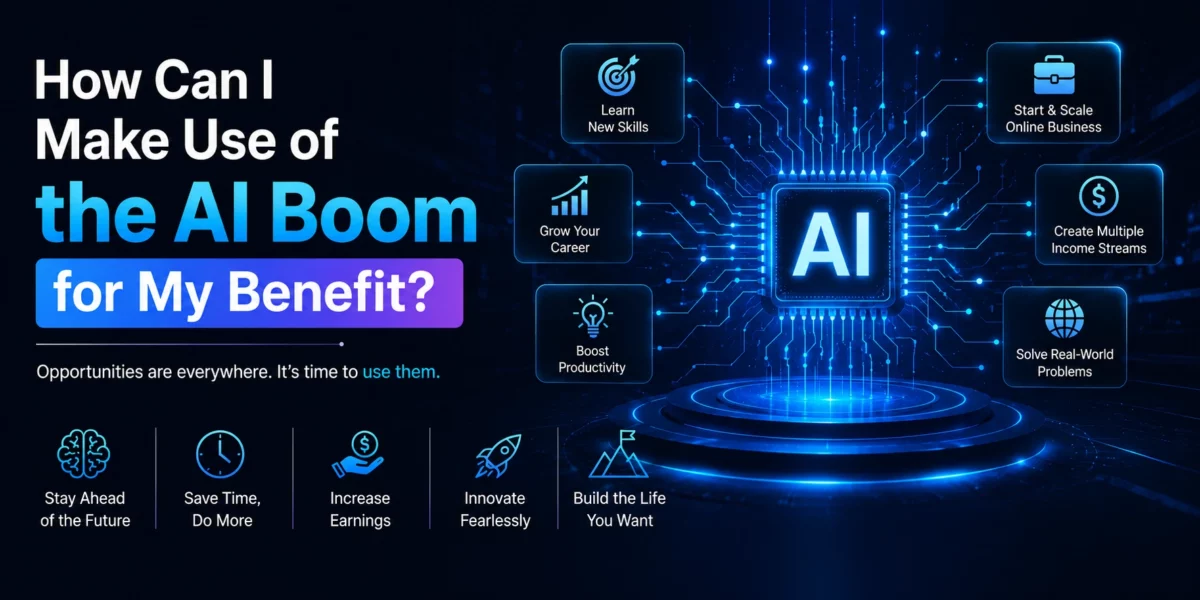
How Can I Make Use of the AI Boom for My Benefit? Lessons from History’s Biggest Technology Revolutions
Throughout history, societies have experienced major technological and economic booms that transformed industries, created new opportunities, and changed the way people worked. Each of these shifts arrived with the same pattern: a period of doubt, followed by rapid adoption, followed by a clear and lasting divide between those who adapted and those who did not.
Some individuals embraced these changes and prospered. Others ignored them and struggled to remain competitive. The gap between these two groups rarely closed on its own – it widened with time, as early adopters compounded their advantage while latecomers tried to catch up from further and further behind.
Today, we are witnessing another transformation. This time, the catalyst is Artificial Intelligence. With Canada’s recent announcement of approximately $2 billion in AI investment and the projected creation of approximately 250,000 AI-related jobs, many people are asking:
How Can I Make Use of the AI Boom for My Benefit?
Before answering that question, it is worth looking at what history can teach us, because every major boom of the past followed a remarkably similar story.
History’s Biggest Booms Created Winners and Losers
The Industrial Revolution
The Industrial Revolution transformed agriculture, manufacturing, transportation, and commerce. It did not simply add new jobs alongside the old ones; it fundamentally rewrote what work looked like for millions of people.
People who learned to work with machines, manufacturing systems, and industrial processes often benefited enormously. Entire industries were created almost overnight. At the same time, those who refused to adapt found their traditional occupations disappearing, often without warning and without an easy path back.
The Automobile Boom
When automobiles became mainstream, many people dismissed them as a passing trend, a novelty for the wealthy that would never replace established forms of transportation.
However, the automobile industry created millions of jobs in:
- Manufacturing
- Transportation
- Engineering
- Logistics
- Sales and Marketing
- Infrastructure Development
The people who entered these industries early often benefited the most, securing positions and building expertise well before the rest of the workforce caught up to the trend.
The Computer Revolution
This is perhaps the most relevant example. In the 1980s, many people believed computers were only for scientists, programmers, and large corporations – not something the average worker would ever need to understand.
I remember teaching Computer Literacy in 1985 and telling people:
“Computer Literacy Is Not a Luxury. It Is a Necessity.”
Many disagreed. At the time, the idea sounded almost exaggerated to some.
Today, computer literacy is expected in virtually every profession. The professionals who learned computer skills expanded their opportunities, often moving into roles and industries that simply did not exist a few years earlier. Those who resisted often found themselves at a disadvantage, watching opportunities pass them by.
The Internet Boom
When the Internet emerged, some businesses embraced it, restructuring how they reached customers and ran their operations. Others ignored it, assuming it was a temporary trend that would not affect their industry.
Today, online commerce, digital marketing, cloud services, online banking, and remote work are part of everyday life. The organizations that adopted digital technologies early often gained significant competitive advantages, while many that waited too long struggled to ever fully close the gap.
The Smartphone Revolution
Many people initially viewed smartphones as expensive gadgets, a luxury item rather than a tool that would reshape entire industries.
Today, smartphones have transformed communication, business operations, banking, education, travel, entertainment, and customer service. Entire industries emerged around mobile applications and digital services, creating career paths that did not exist before the technology itself existed.
The AI Boom May Be Even Bigger
Artificial Intelligence has the potential to impact virtually every profession. Unlike previous technological revolutions that affected specific industries, AI is influencing almost every sector simultaneously, which is part of what makes this particular shift so significant.
Including:
- Healthcare
- Accounting and Finance
- Human Resources
- Supply Chain and Logistics
- Marketing and Sales
- Manufacturing
- Education
- Customer Service
- Cybersecurity
- Information Technology
The organizations and professionals that adapt early may benefit the most, much as they did during every previous wave of technological change. What makes this moment different is the speed at which change is happening. Previous revolutions often took years or even decades to fully reshape an industry. AI adoption, by contrast, is moving across multiple sectors at once, which means the window for early adapters to build an advantage may be shorter than it was in the past.
Survival of the Fittest Has Always Applied to Skills
Charles Darwin’s principle of “survival of the fittest” is often misunderstood. The most successful are not necessarily the strongest. They are often the most adaptable.
The same principle applies to careers and businesses. The professionals who continuously learn and adapt to changing technologies tend to remain relevant, regardless of how much their original field of study or original job description has shifted over time. The organizations that evolve tend to outperform those that resist change.
AI is creating another opportunity to adapt, and like every boom before it, the window to act early will not stay open forever.
What Does This Mean for You?
If You Are a Student
The AI boom may create opportunities across many industries. Developing AI literacy, analytics skills, cybersecurity awareness, and technology-enabled business skills may help you compete in a changing workforce, even in fields that are not traditionally thought of as “technology” careers.
If You Are a Working Professional
You may not need a new career. You may simply need new skills. Professionals who learn how to use AI effectively often become more productive, more efficient, and more valuable to employers, without necessarily having to start over in an entirely different industry.
If You Are a Career Changer
The AI economy is creating opportunities in:
- Cybersecurity
- Data Analytics
- Business Analytics
- Cloud Technologies
- Digital Marketing
- Healthcare Technologies
- Supply Chain Analytics
Many individuals are exploring training programs that prepare them for these emerging opportunities, often discovering that a career change is far more achievable than they initially assumed. With the right combination of training, certification, and hands-on practice, a transition into one of these growing fields can happen in months rather than years, especially compared to the time it once took to retrain for earlier technological shifts.
If You Are a Business Owner
The AI boom may help you:
- Improve productivity
- Reduce costs
- Improve customer service
- Automate repetitive tasks
- Improve forecasting and planning
- Support better decision-making
The greatest return often comes when organizations invest in both technology and workforce development together, rather than treating the two as separate decisions.
If You Are an Employer
Organizations increasingly seek employees who understand:
- Artificial Intelligence
- Data Analytics
- Business Intelligence
- Automation
- Digital Transformation
- Technology-Enabled Decision Making
Upskilling your workforce today may help your organization remain competitive tomorrow, particularly as the gap between AI-literate and AI-unfamiliar organizations continues to widen. Employers who invest in structured training programs now are often better positioned to retain talent, since employees increasingly value organizations that support their long-term skill development rather than leaving them to fall behind.
The Biggest Opportunity Is AI Literacy
The professionals who benefited from the computer revolution were not necessarily programmers. They were people who understood how computers could help them do their jobs more effectively, regardless of their actual job title.
The same principle applies to Artificial Intelligence.
You do not need to become:
- A Programmer
- A Data Scientist
- An AI Engineer
But understanding:
- What AI can do
- What AI cannot do
- How AI affects your profession
- How to use AI responsibly
- How to improve productivity using AI
may become one of the most valuable skills of the next decade, regardless of which industry you work in.
How Canadian College for Higher Studies Can Help
Canadian College for Higher Studies (CCHS) helps individuals and organizations prepare for Canada’s emerging AI economy through a combination of diploma programs, short workshops, and focused skills training. Rather than treating AI as a separate subject reserved for technical specialists, the approach focuses on practical application across business, healthcare, and technology roles, so learners can apply what they study almost immediately in their own workplace.
Diploma Programs
Including:
- Cloud-Based IT Support & Cybersecurity
- Cybersecurity with Artificial Intelligence
- Cloud Data Analytics & Edge AI Security
- Business Administration
- International Business Management, Finance
- Supply Chain & Logistics Management
- Computerized Accounting & Office Administration
- Medical & Health Office Administration
- Graphic Design, Web Design & Digital Marketing
One-Day Workshops
Including:
- Artificial Intelligence for Business Professionals
- AI Productivity and Automation
- AI for Accounting and Payroll Professionals
- AI for Healthcare Administration
- AI for Supply Chain and Logistics Professionals
- Business Forecasting and Analytics
- Data Analytics for Managers
Micro-Skills Training
Focused programs designed to help professionals quickly develop practical AI and technology skills, without the time commitment of a full diploma program.
Funding Opportunities May Be Available
For Individuals
Eligible individuals may wish to explore:
- Better Jobs Ontario (BJO)
- Career Transition Programs
- Workforce Development Initiatives
For Employers
Organizations may wish to explore:
- Ontario Job Grant (OJG)
- Employer Workforce Development Programs
- Employee Upskilling Initiatives
Eligible employers may be able to receive support for approved employee training, workshops, diploma programs, and workforce development initiatives, making it more affordable to prepare an entire team for the changes ahead rather than just a single employee.
History Is Repeating Itself
The Industrial Revolution created opportunities. The Automobile Revolution created opportunities. The Computer Revolution created opportunities. The Internet Revolution created opportunities. The Smartphone Revolution created opportunities.
Now we are entering the Artificial Intelligence Revolution.
Every major boom rewards those who prepare early. Every major boom challenges those who refuse to adapt. History has shown this pattern again and again, and there is little reason to believe the AI revolution will be any different.
The question is not whether AI will affect your future. The question is:
Will You Use the AI Boom to Your Advantage?
Those who study history closely will notice that the answer was never about predicting the future perfectly. It was about being willing to start learning before the change was fully obvious to everyone else. The same opportunity exists today, for students, professionals, career changers, business owners, and employers alike.
About the Author
Donatus Doss President,
Canadian College for Higher Studies (CCHS)
Donatus Doss has spent more than four decades helping individuals and organizations prepare for technological change. In 1985, he taught Computer Literacy and promoted the message:
“Computer Literacy Is Not a Luxury. It Is a Necessity.”
Today, he believes the same principle applies to Artificial Intelligence and workforce development. Through education, workforce training, diploma programs, and corporate learning initiatives, he continues to help students, professionals, employers, and career changers prepare for Canada’s emerging AI economy.
Frequently Asked Questions
Like the Industrial, Computer, and Internet Revolutions before it, the AI boom is reshaping industries simultaneously, including healthcare, finance, marketing, and IT. Adapting early, as with past technology shifts, often determines who benefits most.
No. The biggest opportunity is AI literacy, not technical expertise. Understanding what AI can and cannot do, and how to apply it responsibly in your profession, may become one of the most valuable skills of the next decade.
Students can build AI literacy, analytics skills, cybersecurity awareness, and technology-enabled business skills. These competencies help students compete in a changing workforce, even in fields not traditionally considered technology-focused careers.
Many professionals do not need a new career, just new skills. Learning to use AI effectively often makes employees more productive, more efficient, and more valuable to their current employer, without requiring a complete career change.
Individuals may explore Better Jobs Ontario, career transition programs, and workforce development initiatives. Employers may explore the Ontario Job Grant and employer workforce development programs to help offset training and diploma program costs.
Employers can upskill their workforce in AI, data analytics, automation, and digital transformation. Organizations that invest in both technology and workforce development together often improve productivity, decision-making, and long-term competitiveness.
Latest Post
- What Is Agentic AI? Skills, Careers & Future Job Opportunities
- Best Courses to Get a Job in Canada After Graduation
- AI, IoT and Edge Computing: How These Technologies Work Together
- AI-Powered Cyber Attacks: What Students & Businesses Must Know
- What Is Healthcare Administration and Is It Good in Canada?