
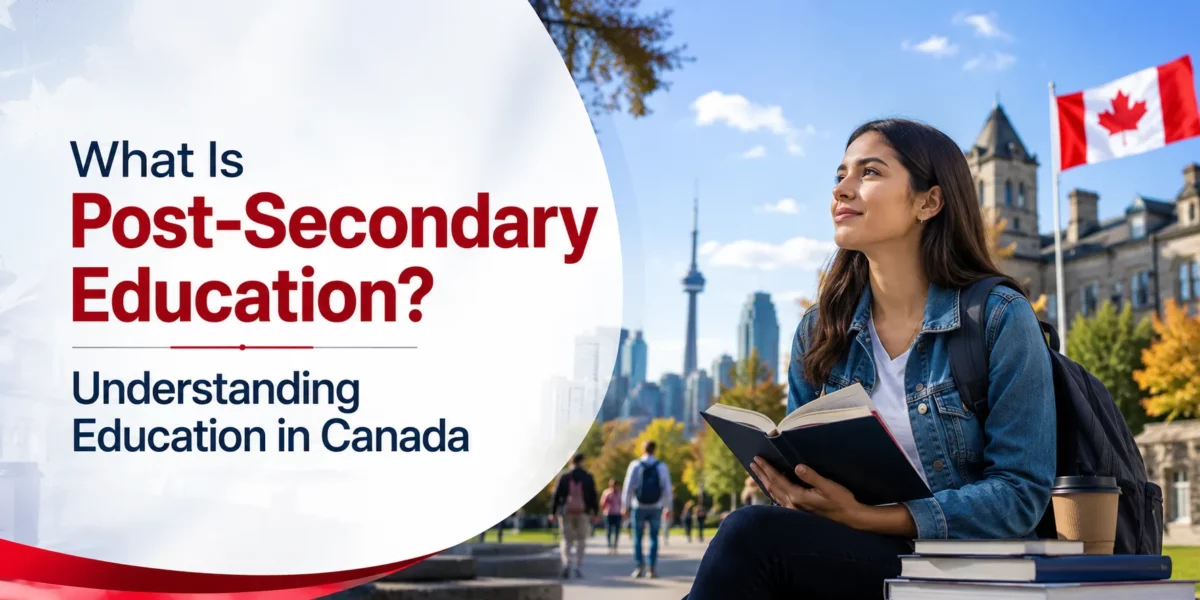
Introduction: What Is Post-Secondary Education?
Post-secondary education is any formal learning that happens after high school, including college, university, and other accredited programs that lead to a certificate, diploma, or degree. In Canada, it’s provincially regulated, which means the exact structure shifts a little depending on where a student studies.
It’s the stage where students move from general education into something more focused, whether that’s a trade, a profession, or an academic field. For international students especially, understanding how this stage works in Canada matters before choosing a program.
What Is Post-Secondary Education?
Post-secondary education is the term used for any structured learning that comes after secondary school. Secondary school in most countries ends around grade 12, and that’s exactly where this next stage picks up.
This isn’t one single thing. It covers colleges, universities, technical institutes, and specialized training schools, all offering programs that build on what students already learned in high school.
The core idea is specialization. Where high school covers a broad range of subjects, post-secondary education lets a student focus on a specific field, whether that’s business, healthcare, engineering, or the trades.
What Is Post-Secondary Education in Canada?
What is post-secondary education in Canada looks a lot like the general definition, but with some country-specific structure. Canada doesn’t have one national education system, each province and territory runs its own, which means program names and structures can shift slightly depending on where you study.
Broadly, though, what is a post-secondary education in Canada usually falls into two main institution types: colleges and universities. Colleges tend to focus on applied, career-ready skills, while universities lean toward academic and research-based learning.
Where a lot of general explainers stop at that broad split, it’s worth knowing that oversight sits at the provincial level too. In Ontario, for instance, private career colleges are regulated under the Ontario Career Colleges Act, which is a useful reference point when comparing how legitimate a specific institution actually is.
Quebec runs a bit differently, with CEGEP (a two-year pre-university or technical program) sitting between high school and university. It’s a good example of how post-secondary education isn’t identical from coast to coast, even within one country.
Secondary vs Post-Secondary Education in Canada
Students often mix up what is secondary and post secondary education, especially when comparing systems from other countries. The table below lays out the basic differences.
| Aspect | Secondary Education | Post-Secondary Education |
| Education level | High school | College, university, or institute |
| Typical age/stage | Roughly 14 to 18 | 18 and older, or after high school completion |
| Purpose | Broad, general education | Focused, specialized training |
| Examples | Grade 9 to Grade 12 courses | Diploma, degree, or certificate programs |
| Credential earned | High school diploma | Certificate, diploma, or degree |
| What comes next | Post-secondary education or the workforce | Employment, further study, or graduate school |
Secondary school gives students a broad foundation. Post-secondary education builds a specific skill set or academic focus on top of that foundation, which is really the whole point of choosing a program in the first place.
What Is a Post-Secondary Program?
A post-secondary program is a structured course of study offered by a college, university, or institute after high school. Each one has its own length, focus, and credential waiting at the end.
Programs generally fall into a few categories. Certificate programs are the shortest, often 6 months to a year, and focus on a specific skill set. Diploma programs usually run 1 to 2 years and cover a broader base of knowledge in a field.
Advanced diploma programs go a bit further, typically 2 to 3 years, often layering in more technical or specialized coursework. Degree programs, whether at a college or university, generally take 3 to 4 years for a bachelor’s level credential. Graduate programs sit above that, for students who already hold an undergraduate degree and want to specialize further.
What Is a Post-Secondary Degree?
A post-secondary degree is an academic credential awarded after completing a degree-level program, most commonly a bachelor’s degree. It sits at a different level than a diploma or certificate, both in depth and typically in duration.
Here’s how the three usually compare:
| Credential | Typical Length | Focus |
| Certificate | 6 months to 1 year | Narrow, specific skill |
| Diploma | 1 to 2 years | Broader applied knowledge |
| Degree | 3 to 4 years (bachelor’s) | Academic depth, theory plus application |
What is a post secondary degree really comes down to depth and recognition. A degree usually involves more coursework, more research or theoretical grounding, and is generally the entry point for professions that require formal academic credentials, like teaching, engineering, or law school admission later on.
Types of Post-Secondary Education in Canada
Canada offers several paths after high school, and none of them is automatically “better” than another. It depends entirely on the career or goal a student has in mind.
College Programs
Colleges in Canada focus heavily on applied, job-ready training. Programs often include certificates, diplomas, and advanced diplomas, and many include a practical placement or co-op component built into the curriculum.
This route tends to suit students who want a shorter path to employment, or who prefer hands-on learning over purely theoretical coursework. Career-focused diploma programs in fields like IT, business, and healthcare are a common example of this model.
University Programs
Universities in Canada offer degree programs, from bachelor’s degrees through to graduate study. The focus here leans more academic, with lectures, research, and theory forming a bigger part of the curriculum.
Some fields, like medicine, law, or academic research, specifically require a university degree as the entry point.
Diploma and Certificate Programs
These are often the fastest route into a specific job market. A diploma or certificate program targets a defined skill set, things like accounting, digital marketing, or hospitality management, without the broader academic requirements of a full degree.
Many college programs are designed with direct industry input, which keeps the curriculum closely tied to what employers are actually looking for. Certificate programs in particular are built for students who want to enter the workforce quickly.
Graduate and Professional Education
Graduate education comes after an undergraduate degree, covering master’s and doctoral programs. Professional education, like teacher’s college or certain healthcare specializations, often requires a prior degree as well.
This level is generally for students aiming at research careers, advanced specialization, or professions with formal licensing requirements.
Why Do Students Choose Post-Secondary Education?
The reasons usually come down to a few practical outcomes rather than abstract ideals.
Career preparation is the biggest one. Most jobs beyond entry-level positions expect some form of post-secondary credential, whether that’s a diploma, degree, or professional certification.
Specialized skills matter too. High school gives a general foundation, but employers in most fields want to see training specific to the role, something post-secondary programs are built around.
Professional qualifications are another factor. Fields like nursing, accounting, and engineering have licensing bodies that require a specific credential before someone can practice. Further education and stronger employment opportunities tend to follow naturally from that.
There’s also personal and academic development that comes with specialized study, though that’s usually a secondary benefit rather than the main reason someone enrolls.
Post-Secondary Education for International Students in Canada
For international students, post-secondary education in Canada involves a few extra layers beyond just picking a program.
Choosing a program starts the same way it does for domestic students, based on career goals and interests. Admission requirements, though, often include additional documentation for applicants coming from outside Canada, and these vary by institution and program.
English language requirements typically apply if a student’s prior education wasn’t conducted in English. Most institutions accept standardized test scores as proof of proficiency, though the specific tests and score thresholds differ by school.
Study permit considerations are a real part of planning for most international students, since studying in Canada generally requires a valid study permit issued by Immigration, Refugees and Citizenship Canada (IRCC). Requirements and processes can change, so it’s worth checking directly with IRCC’s official website or a regulated immigration consultant for current rules rather than relying on older information.
Tuition planning matters more for international students too, since international fees are generally higher than domestic tuition. Program duration and career planning should factor into this decision as well, since a longer program means a longer financial and time commitment before entering the workforce. The international students section of a school’s own website is usually the most current source for program-specific admission and planning details.
How to Choose the Right Post-Secondary Program
A few practical factors should shape this decision more than reputation alone.
Career goals come first. It’s worth working backward from the job or field a student wants, then checking which credential level that career actually requires.
Program length and tuition affect both timeline and budget. A three-year advanced diploma is a very different commitment than a one-year certificate, both in cost and in how soon a student can start working.
Location matters for logistics, and admission requirements vary enough between schools that it’s worth checking specifics rather than assuming. Program curriculum should align with actual career interests, not just a program’s name.
Career outcomes and student support services are worth researching directly with the institution. Further study options matter too, particularly for students who might want to continue into a degree or graduate program down the line.
Post-Secondary Education and Career Planning
The program a student chooses shapes their career options more than most other early decisions. A diploma in a specific trade opens a fairly direct path into that trade. A general arts degree, by contrast, tends to open broader options but with less direct specialization.
Neither path is inherently better. What matters is matching the credential to the actual career target. Someone aiming for a licensed profession needs to check exactly which credential that license requires before choosing a program, since not every post-secondary path leads to every career.
It also helps to think beyond the first job. Some fields reward further study over time, while others value direct work experience just as much as the initial credential.
Final Thoughts
Post-secondary education in Canada isn’t a single path, it’s a range of options built around different goals, timelines, and career outcomes. Whether that means a one-year certificate or a four-year degree depends entirely on what a student is trying to reach at the end of it.
For students exploring programs, admission requirements, or what a specific credential leads to, reaching out to an admissions team directly is usually the fastest way to get accurate, current answers. You can also read more about how a specific institution operates before applying, since accreditation and program focus vary a lot between schools.
Sources
Study permit and immigration information referenced from Immigration, Refugees and Citizenship Canada. Ontario private career college regulation referenced from the Ontario Career Colleges Act, 2005. Program structure details reflect general Canadian post-secondary norms and can vary by province, institution, and field of study. Always confirm current admission requirements and immigration rules directly with the institution or IRCC before making a decision.
Frequently Asked Questions
It’s any formal education completed after high school, including college, university, and other accredited programs that lead to a certificate, diploma, or degree.
In Canada, it typically means college or university study after high school (or CEGEP in Quebec), offered through provincially regulated institutions across the country.
Yes. College programs, including certificates, diplomas, and advanced diplomas, are a recognized form of post-secondary education in Canada.
Yes. University degree programs, from bachelor’s through graduate level, fall under post-secondary education as well.
It’s a structured course of study offered after high school, ranging from short certificate programs to multi-year degree programs, each ending in a specific credential.
A degree is an academic credential, typically a bachelor’s degree, awarded after 3 to 4 years of university-level study, generally more theoretical and research-focused than a diploma.
Secondary education is general high school study, while post-secondary education is specialized training or academic study that comes after, leading to a certificate, diploma, or degree.
Yes. Diplomas, along with certificates and degrees, are all recognized post-secondary credentials in Canada.
Yes, international students can study at Canadian colleges and universities, though this generally requires a valid study permit and meeting each institution’s specific admission requirements.
Career goals, program length, tuition, location, admission requirements, and career outcomes are the main factors worth researching before choosing a program.
Latest Post
- What Is Agentic AI? Skills, Careers & Future Job Opportunities
- Best Courses to Get a Job in Canada After Graduation
- AI, IoT and Edge Computing: How These Technologies Work Together
- AI-Powered Cyber Attacks: What Students & Businesses Must Know
- What Is Healthcare Administration and Is It Good in Canada?