

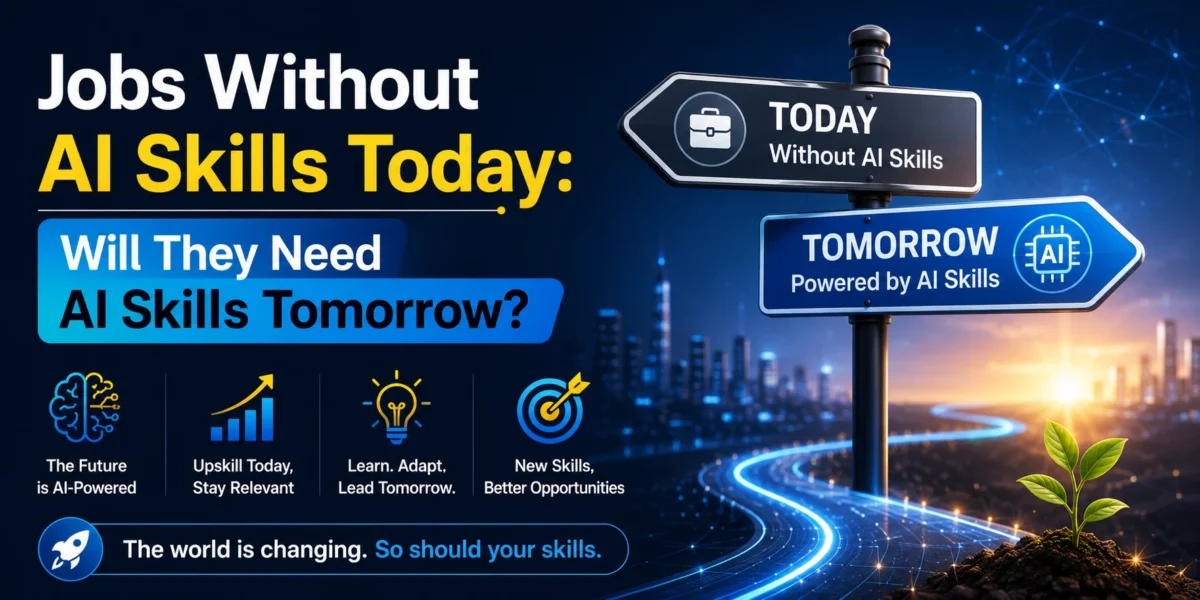
Which jobs can survive without AI skills today, and which jobs will require AI literacy tomorrow?
One of the most common questions people ask is:
“Do I really need AI skills for my job?”
The answer depends on two things:
- Your profession today.
- Your profession five years from now.
Many jobs currently require little or no direct use of Artificial Intelligence. Workers in skilled trades, personal services, and community care roles are still performing their daily tasks without interacting with AI systems in any meaningful way. For many of these individuals, AI feels like a distant concept – something relevant to tech companies or software engineers, not to their everyday work. This is an understandable perspective. If your job has not changed in years and your employer has not mentioned AI once, it is natural to assume that it simply does not apply to you.
But this assumption has been made before. And history has shown, repeatedly, that it does not hold.
Think about how the workplace looked before personal computers became widespread. In the early 1980s, most offices relied on typewriters, paper files, and manual bookkeeping. The idea that every employee – from a receptionist to a store manager to a factory supervisor – would one day need to be comfortable with computers seemed unlikely to many people at the time. Yet within twenty years, basic computer skills had become a hiring requirement across nearly every industry in Canada and around the world.
The same transition happened with the Internet. When email first emerged as a communication tool, many workers dismissed it as something for tech professionals. Today, not checking email is not an option in most workplaces. Then came smartphones. Then social media. Then cloud software. Each time, a technology that once seemed niche became universal.
Artificial Intelligence is now following that same path – and it is moving faster than any of its predecessors.
This does not mean that your job will disappear. In most cases, it means your job will change. The tasks you perform, the tools you use, and the skills your employer values may all shift over the coming years. Understanding where that shift is headed – and how it applies to your specific profession – is one of the most valuable things you can do for your career right now.
- The same thing happened with computers.
- The same thing happened with the Internet.
- The same thing happened with smartphones.
- The same thing is now happening with AI.
The question is not whether AI will arrive in your industry. The question is when – and whether you will be prepared when it does.
Jobs That Currently Require Minimal AI Skills
While no profession is completely immune from the long-term influence of technology, certain roles still operate largely without AI involvement. These jobs depend on physical presence, human judgment, personal relationships, and hands-on skills that have proven difficult to replicate with current technology.
Skilled Trades
Examples:
- Electricians
- Plumbers
- Carpenters
- Welders
- HVAC Technicians
Typical Ontario Salary Range: $50,000 – $120,000+
Growth Potential: Strong
Skilled trades represent some of the most resilient and in-demand careers in Canada. These roles require physical presence, problem-solving in unpredictable environments, and hands-on expertise that cannot be easily automated. A plumber diagnosing a leak behind a wall, or an electrician rewiring an older building, brings a combination of experience and judgement that goes far beyond what any algorithm can replicate today.
That said, AI is beginning to assist with scheduling, diagnostics, project planning, estimating, and predictive maintenance. Building management systems and smart infrastructure increasingly use AI to monitor performance and flag issues before they become serious problems. Tradespeople who understand how to interpret and work alongside these systems may find themselves with a competitive edge in the years ahead.
Personal Care Services
Examples:
- Hairstylists
- Barbers
- Estheticians
- Massage Therapists
Typical Ontario Salary Range: $35,000 – $90,000+
Growth Potential: Moderate to Strong
Personal care is one of the most relationship-driven sectors in the economy. Clients return to their favourite hairstylist not just for the cut, but for the conversation, the comfort, and the trust built over years of visits. This human dimension makes the core service genuinely difficult to automate.
However, the business operations surrounding these services are already being touched by AI. Appointment scheduling tools, AI-powered customer management platforms, social media content generators, and automated marketing campaigns are becoming standard tools for salon owners and independent practitioners alike. Understanding and using these tools effectively can help personal care professionals grow their client base, reduce no-shows, and manage their businesses more efficiently.
Healthcare Support Roles
Examples:
- Personal Support Workers (PSWs)
- Community Support Workers
- Senior Care Assistants
Typical Ontario Salary Range: $40,000 – $75,000+
Growth Potential: Very Strong
Healthcare support roles sit at the intersection of empathy, physical care, and human connection. Personal Support Workers provide assistance with daily living activities, companionship, and emotional support – qualities that AI cannot replicate in any meaningful sense. As Canada’s population ages, demand for these professionals is expected to grow significantly over the next decade.
Despite this, digital health technologies and AI-assisted monitoring systems are becoming increasingly common in care settings. Wearable devices that track patient vitals, AI platforms that flag changes in patient behaviour, and digital documentation systems are all entering the workplace. Healthcare support workers who are comfortable with these technologies will be better positioned in modern care environments.
Hospitality and Tourism
Examples:
- Event Coordinators
- Guest Services Staff
- Hospitality Supervisors
Typical Ontario Salary Range: $40,000 – $95,000+
Growth Potential: Strong
Hospitality is built on memorable human experiences. A warm welcome at a hotel reception, a well-executed event, or a genuinely attentive server creates the kind of experience that guests remember and recommend. These moments of genuine human service remain at the heart of the industry.
At the same time, AI is increasingly supporting customer service systems, reservation platforms, demand forecasting, revenue management, and operational planning behind the scenes. Hotels and large event venues are already using AI tools to predict booking patterns, personalize guest communications, and optimize staffing levels. Professionals in this sector who understand these tools will be better equipped to advance into supervisory and management roles.
Jobs Already Being Influenced by AI
The following professions are already experiencing meaningful AI integration. In these fields, professionals who develop AI literacy are gaining a measurable advantage over those who do not.
Accounting and Finance
Typical Ontario Salary Range: $50,000 – $140,000+
Growth Potential: Strong
Accounting and finance have always involved large volumes of structured data – exactly the kind of environment where AI performs exceptionally well. Machine learning tools are now being used to automate reconciliation, generate financial reports, identify anomalies, and provide forward-looking forecasts that would have taken analysts days to produce manually.
AI is helping with:
- Reporting
- Analysis
- Forecasting
- Payroll
- Financial decision support
This does not mean that accountants and financial analysts are being replaced. It means the nature of their work is shifting. Professionals who can interpret AI-generated insights, validate their accuracy, and apply them to real business decisions will be significantly more valuable than those who cannot. Those who understand AI may gain a clear competitive advantage in hiring, promotion, and compensation.
Human Resources
Typical Ontario Salary Range: $55,000 – $130,000+
Growth Potential: Strong
Human Resources is another field experiencing rapid AI integration. Recruitment platforms now use AI to screen resumes, rank candidates, and schedule interviews. Workforce analytics tools help HR teams identify patterns in employee engagement, absenteeism, and performance. Learning management systems use AI to personalize training content for individual employees.
AI is increasingly used for:
- Recruitment support
- Workforce analytics
- Employee engagement
- Training administration
HR professionals who understand how to work with these tools – and who can critically evaluate their outputs for fairness and accuracy – will be in high demand. As organizations grow more dependent on data-driven people management, HR literacy in AI will become a distinguishing qualification.
Marketing and Sales
Typical Ontario Salary Range: $50,000 – $150,000+
Growth Potential: Very Strong
Few industries have been transformed by AI as visibly as marketing and sales. AI tools now generate content, segment audiences, personalize messaging, predict customer behaviour, and optimize advertising budgets in real time. What once required entire teams of analysts and creatives can now be accomplished with a fraction of the resources – provided someone knows how to use the tools effectively.
AI is transforming:
- Content creation
- Customer analytics
- Campaign optimization
- Lead generation
Marketing professionals who develop strong AI skills are producing better results with smaller budgets. Sales teams using AI-powered CRM tools are identifying higher-quality leads and closing deals faster. In this field, AI literacy is already separating top performers from average ones.
Supply Chain and Logistics
Typical Ontario Salary Range: $55,000 – $140,000+
Growth Potential: Very Strong
Supply chain and logistics is one of the fields where AI is delivering the most measurable impact. From warehouse automation to route optimization to demand forecasting, AI systems are helping organizations move goods faster, reduce waste, and respond more effectively to disruptions.
AI helps organizations:
- Forecast demand
- Optimize inventory
- Improve transportation planning
- Reduce operational costs
The pandemic exposed significant vulnerabilities in global supply chains, accelerating investment in AI-driven supply chain technologies. Professionals in this field who understand data analytics, AI forecasting tools, and automation systems are among the most sought-after in Canada’s logistics sector.
Healthcare Administration
Typical Ontario Salary Range: $45,000 – $100,000+
Growth Potential: Strong
Healthcare administration is evolving rapidly as hospitals, clinics, and long-term care facilities adopt digital health platforms, electronic medical records systems, and AI-powered analytics tools. Administrative professionals who can navigate these systems are increasingly valuable to healthcare organizations.
AI is increasingly supporting:
- Digital health systems
- Patient monitoring
- Healthcare analytics
- Administrative efficiency
Understanding how to work with these systems – entering data accurately, generating reports, and supporting clinical staff – is becoming a core competency for healthcare administrators across Canada.
Information Technology
Typical Ontario Salary Range: $60,000 – $180,000+
Growth Potential: Very Strong
Information Technology is perhaps the field most deeply and immediately affected by AI. AI tools are being used to detect cybersecurity threats in real time, automate cloud infrastructure management, assist with software development, and improve IT support response times. In some organizations, AI is handling the first line of technical support entirely.
AI is already influencing:
- Cybersecurity
- Cloud Computing
- Software Development
- IT Support
- Network Administration
For IT professionals, understanding AI is no longer optional. Organizations are actively seeking candidates who can work with AI-integrated security platforms, cloud AI services, and intelligent automation tools. Salaries in AI-adjacent IT roles are among the highest in the Canadian job market.
The Real Question Is Not Whether AI Will Affect Your Job
The real question is:
How Much of Your Job Can Be Improved by AI?
In the 1980s, many people believed computers were only necessary for programmers. Office workers, teachers, tradespeople, and business owners saw no reason to learn computer skills. Within a generation, that assumption had been completely overturned. Today, computer literacy is expected in almost every profession – from filing a tax return to managing a small business to applying for a job.
The same pattern is emerging with AI. The early adopters are gaining advantages today. The late adopters will be catching up tomorrow.
The Future Workplace
What Employers May Expect Five Years From Now
Five years from now, employers may increasingly expect professionals to understand:
- AI Productivity Tools
- Data Analytics
- Business Intelligence
- Automation Technologies
- Digital Workflows
This does not mean everyone must become a programmer. A nurse does not need to write machine learning code. An electrician does not need to build AI models. A hospitality manager does not need to understand neural networks.
It means AI literacy may become as important as computer literacy became decades ago. Just as workers in the 1990s were expected to learn word processing and email, workers in the 2030s may be expected to understand how to use AI-assisted tools relevant to their field.
The standard will vary by profession. But the direction is consistent across industries.
The Winners Will Be the Adapters
History teaches us an important lesson. Technological revolutions do not eliminate human work – they transform it. And the people who come out ahead are almost always the ones who chose to adapt rather than wait.
- The Industrial Revolution rewarded those who adapted.
- The Computer Revolution rewarded those who adapted.
- The Internet Revolution rewarded those who adapted.
- The AI Revolution will likely do the same.
The greatest opportunities often go to those who prepare before change becomes mandatory. Waiting until AI literacy is required by employers means competing with a much larger pool of already-prepared candidates. Starting now means building skills, confidence, and experience while others are still deciding whether to begin.
The workers who thrived through previous technological transitions were not necessarily the most naturally talented. They were the ones who stayed curious, invested in learning, and were willing to update their skills when the world around them changed.
How Canadian College for Higher Studies Can Help
At Canadian College for Higher Studies (CCHS), we help individuals and organizations prepare for Canada’s emerging AI economy. Our programs are designed to provide practical, job-ready skills that reflect what Canadian employers are actually looking for – not theory for its own sake, but applied knowledge that opens doors.
Whether you are starting your career, changing industries, or upgrading your skills in your current field, CCHS offers a pathway tailored to your goals.
Technology and AI Programs
- Cloud-Based IT Support & Cybersecurity
- Cybersecurity with Artificial Intelligence
- Cloud Data Analytics & Edge AI Security
- Advanced Diploma in AI, Deep Learning & Natural Language Processing
- Security and Automation of Multi-Cloud Containerized Workloads
- Enterprise Linux & Application Security Engineering
- Post-Graduate Diploma in Enterprise Cybersecurity & Governance Automation
Business and Professional Programs
- Business Administration
- International Business Management, Finance
- Supply Chain & Logistics Management
- Computerized Accounting & Office Administration
- Medical & Health Office Administration
- Graphic Design, Web Design & Digital Marketing
One-Day Workshops
For professionals who want to build AI literacy without committing to a full diploma program, our one-day workshops offer focused, practical training in a single session:
- Artificial Intelligence for Business Professionals
- AI Productivity and Automation
- Business Forecasting and Analytics
- AI for Accounting and Payroll Professionals
- AI for Healthcare Administration
- AI for Supply Chain and Logistics Professionals
Funding Opportunities May Be Available
One of the most common barriers to professional development is cost. CCHS works with a range of government-funded programs that may reduce or eliminate tuition costs for eligible individuals and employers.
For Individuals
- Better Jobs Ontario (BJO) – Provides funding support for eligible unemployed individuals seeking to upgrade their skills for in-demand careers.
- Career Transition Programs – Support for individuals looking to move into new fields or industries.
For Employers
- Ontario Job Grant (OJG) – Helps Ontario employers fund employee training, with the government covering a significant portion of eligible training costs.
- Workforce Development Funding Programs – Additional options for organizations investing in team-wide skills development.
Speak with our admissions team to find out which funding options may apply to your situation.
The Bottom Line
There are still jobs today that require little direct interaction with Artificial Intelligence. Many skilled, caring, and talented professionals are doing excellent work in fields where AI has not yet made a significant difference to day-to-day tasks.
But the number of jobs that will remain completely untouched by AI is shrinking. The trajectory is clear – and it points in one direction.
The future may not belong to AI.
The future may belong to people who understand how to use AI effectively.
The question is not:
“Will AI affect my career?”
The question is:
“Will I be ready when it does?”
At Canadian College for Higher Studies, we believe the answer should always be yes. Our programs, workshops, and funding support options are designed to help you take the next step – on your timeline, at your pace, with the practical skills that today’s employers are actively looking for.
FAQ’s
Currently, skilled trades rely on hands-on expertise and physical presence. However, AI is already assisting with scheduling, diagnostics, and predictive maintenance. Tradespeople who understand these tools may gain a competitive advantage in the years ahead.
The core human experience in personal care is difficult to automate. However, AI is already being used for appointment scheduling, customer management, and marketing. Understanding these tools helps personal care professionals run more efficient and profitable businesses.
AI is automating reconciliation, financial reporting, forecasting, and payroll tasks. Accountants and financial analysts who can interpret AI-generated insights and apply them to business decisions will be significantly more valuable to employers than those who cannot.
Fields including IT, marketing, supply chain, HR, accounting, and healthcare administration are already experiencing meaningful AI integration. Professionals in these sectors who develop AI literacy are gaining measurable advantages in hiring, compensation, and career advancement opportunities.
CCHS offers diploma programs in cybersecurity, cloud computing, AI, data analytics, and business administration. One-day workshops are also available for professionals seeking focused AI skills training. Funding through Better Jobs Ontario and Ontario Job Grant may be available for eligible individuals and employers.
Latest Post
- What Is Agentic AI? Skills, Careers & Future Job Opportunities
- Best Courses to Get a Job in Canada After Graduation
- AI, IoT and Edge Computing: How These Technologies Work Together
- AI-Powered Cyber Attacks: What Students & Businesses Must Know
- What Is Healthcare Administration and Is It Good in Canada?