

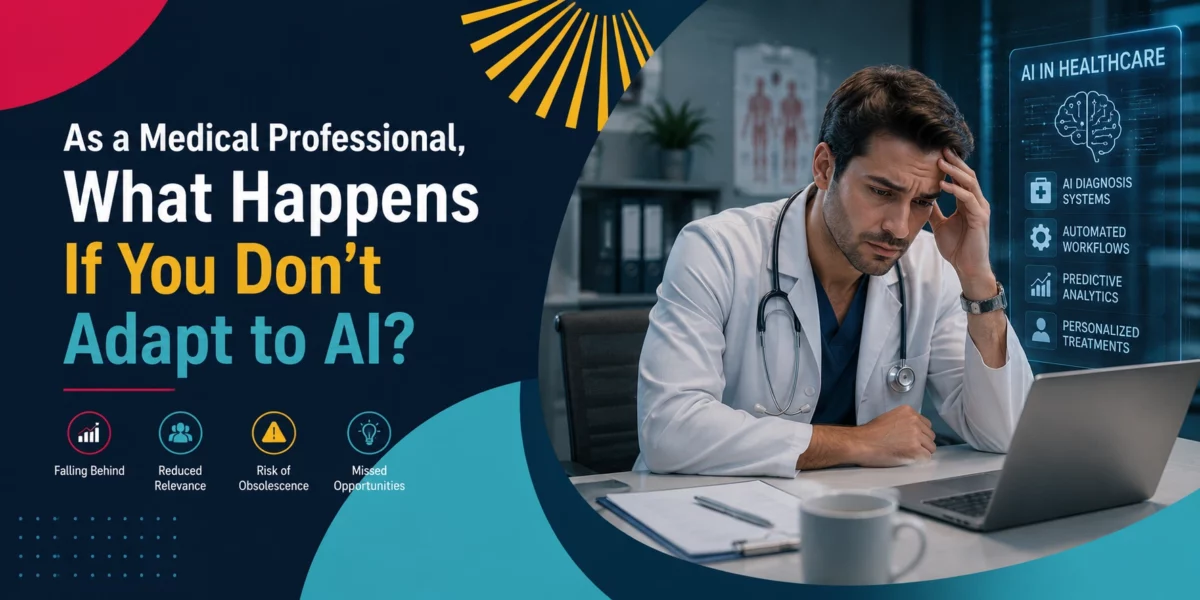
As a Medical Professional, What Happens If I Don’t Adapt to AI?
Healthcare is changing.
Artificial Intelligence (AI), digital health technologies, predictive analytics, remote patient monitoring, intelligent diagnostics, and automation are rapidly transforming healthcare systems across Canada and around the world.
Governments, hospitals, clinics, healthcare networks, and technology companies are investing billions of dollars to improve healthcare delivery, patient outcomes, operational efficiency, and access to care.
The question many healthcare professionals should be asking is:
What Happens If I Don’t Adapt?
The answer may have a significant impact on your future career opportunities.
AI Is Not Replacing Medical Professionals
Let’s begin with an important fact.
Artificial Intelligence is not replacing doctors, nurses, healthcare administrators, therapists, pharmacists, or healthcare support professionals.
Healthcare will always require:
• Clinical expertise
• Human judgment
• Empathy and compassion
• Communication skills
• Critical thinking
• Ethical decision-making
However, AI is becoming a powerful tool that helps healthcare professionals work more effectively.
The professionals who learn how to work alongside AI will often have an advantage over those who do not.
Healthcare Is Becoming Increasingly Digital
Today’s healthcare environment relies heavily on technology.
Healthcare professionals are increasingly expected to work with:
• Electronic Medical Records (EMR)
• Telehealth systems
• Digital patient records
• Healthcare analytics platforms
• Clinical decision support tools
• Remote patient monitoring systems
• AI-assisted documentation tools
• Healthcare information systems
The healthcare workplace of tomorrow will be even more technology-enabled.
What Could Happen If You Don’t Adapt?
Reduced Career Opportunities
Healthcare employers increasingly seek professionals who are comfortable using modern healthcare technologies.
Those who understand digital health systems and AI-assisted tools may have access to broader career opportunities.
Increased Administrative Burden
Professionals who leverage technology effectively can often reduce repetitive administrative work and spend more time focusing on patient care.
Difficulty Adapting to New Healthcare Systems
Healthcare organizations continue to modernize operations.
Professionals who resist technological change may find it more difficult to adapt to evolving workplace expectations.
Falling Behind Industry Trends
AI-assisted diagnostics, predictive analytics, digital health platforms, and patient monitoring technologies are becoming increasingly common.
Healthcare professionals who understand these technologies may be better positioned for future growth.
How AI Is Helping Healthcare Professionals
Artificial Intelligence is already supporting healthcare in many ways.
Patient Monitoring, Edge AI and Intelligent Diagnostics
Healthcare organizations are increasingly using Edge AI technologies to analyze patient data closer to where it is generated, enabling real-time monitoring, faster clinical insights, improved privacy, and more responsive healthcare interventions. These technologies can support healthcare professionals in identifying changes in patient conditions, monitoring chronic diseases, and enhancing diagnostic workflows.
Diagnostics Support
Healthcare providers can use AI-assisted tools to help analyze medical information and support clinical decision-making.
Patient Monitoring, Edge AI and Intelligent Diagnostics
Healthcare organizations are increasingly using Edge AI technologies to analyze patient data closer to where it is generated, enabling real-time monitoring, faster clinical insights, improved privacy, and more responsive healthcare interventions.
Healthcare Analytics, Edge AI and Data-Driven Care
Modern healthcare organizations leverage analytics, Artificial Intelligence, and Edge AI technologies to identify trends, predict health risks, improve patient outcomes, optimize healthcare operations, and support evidence-based decision-making across the continuum of care.
Administrative Efficiency
AI can assist with:
• Scheduling
• Documentation
• Medical records management
• Billing support
• Workflow automation
Population Health Management
Healthcare organizations increasingly use analytics and AI to support preventive care and improve community health outcomes.
What Skills Should Medical Professionals Develop?
You do not need to become a programmer.
You do not need to become a data scientist.
However, healthcare professionals who understand the following areas may have a significant advantage:
Digital Health Technologies
Understanding modern healthcare information systems and digital workflows.
Electronic Medical Records (EMR)
Working efficiently with electronic patient records and healthcare documentation systems.
Healthcare Analytics
Understanding how healthcare data can improve patient care and operational performance.
Artificial Intelligence Awareness
Understanding the capabilities, limitations, and appropriate use of AI in healthcare environments.
Healthcare Cybersecurity and Privacy
Protecting patient information is becoming increasingly important as healthcare systems become more digital.
Remote Patient Monitoring
Understanding technologies that support patient care beyond traditional clinical settings.
The Future Healthcare Professional Will Combine Care and Technology
The healthcare professionals of tomorrow will not simply deliver care.
They will also understand how technology can help improve:
• Patient outcomes
• Care coordination
• Clinical efficiency
• Population health
• Healthcare accessibility
• Healthcare decision-making
The future belongs to professionals who can combine healthcare expertise with technology awareness.
How Canadian College for Higher Studies Can Help
Canadian College for Higher Studies (CCHS) offers programs designed to help healthcare and healthcare-support professionals prepare for a technology-driven future.
Medical & Health Office Administration
Preparing healthcare administrators for digital health and AI-assisted healthcare environments.
Students develop skills in:
• Electronic Medical Records (EMR)
• Healthcare administration
• Medical billing and office procedures
• Healthcare communication
• Digital health technologies
• Healthcare information management
Cloud Data Analytics & Edge AI Security
Preparing healthcare analytics professionals for secure patient monitoring and intelligent diagnostics.
Students learn:
• Healthcare analytics
• Predictive AI concepts
• Cloud databases
• Data security
• Patient monitoring technologies
• AI-assisted diagnostics support
One-Day Workshops and Micro-Skills Training
Healthcare organizations can also benefit from:
• AI for Healthcare Administration
• Digital Health Technologies
• Healthcare Data Analytics
• Cybersecurity Awareness for Healthcare Staff
• AI Productivity Tools for Healthcare Professionals
The Choice Is Yours
Healthcare is not becoming less human.
It is becoming more intelligent, more connected, and more data driven.
Artificial Intelligence will not replace healthcare professionals.
However, healthcare professionals who understand AI, digital health technologies, analytics, and modern healthcare systems may increasingly outperform those who do not.
The question is not whether AI will affect healthcare.
The question is whether you will be ready when it does.
Contact Canadian College for Higher Studies to learn about diploma programs, workshops, micro-skills training, and workforce development opportunities that can help you prepare for the future of healthcare.
Frequently Asked Questions
No. Artificial Intelligence is designed to assist healthcare professionals, not replace them. Doctors, nurses, healthcare administrators, therapists, and pharmacists will continue to play a vital role in patient care and clinical decision-making.
As healthcare becomes more digital, professionals who understand AI, healthcare analytics, and digital health technologies can improve efficiency, support better patient outcomes, and remain competitive in the evolving healthcare landscape.
Healthcare organizations are increasingly adopting Electronic Medical Records (EMR), telehealth platforms, healthcare analytics, remote patient monitoring systems, AI-assisted documentation tools, and intelligent diagnostic technologies to improve care delivery.
Healthcare professionals who do not adapt to technological changes may find it more difficult to keep pace with modern healthcare environments. Those who develop digital skills are likely to have access to stronger career opportunities.
Healthcare professionals can strengthen their careers by gaining knowledge in digital health technologies, Electronic Medical Records (EMR), healthcare analytics, AI awareness, cybersecurity, privacy protection, and remote patient monitoring.
Future healthcare professionals will combine clinical expertise with technology awareness to improve patient outcomes, increase efficiency, enhance care coordination, and support data-driven healthcare decisions.
Read More
- What Is Agentic AI? Skills, Careers & Future Job Opportunities
- Best Courses to Get a Job in Canada After Graduation
- AI, IoT and Edge Computing: How These Technologies Work Together
- AI-Powered Cyber Attacks: What Students & Businesses Must Know
- What Is Healthcare Administration and Is It Good in Canada?