

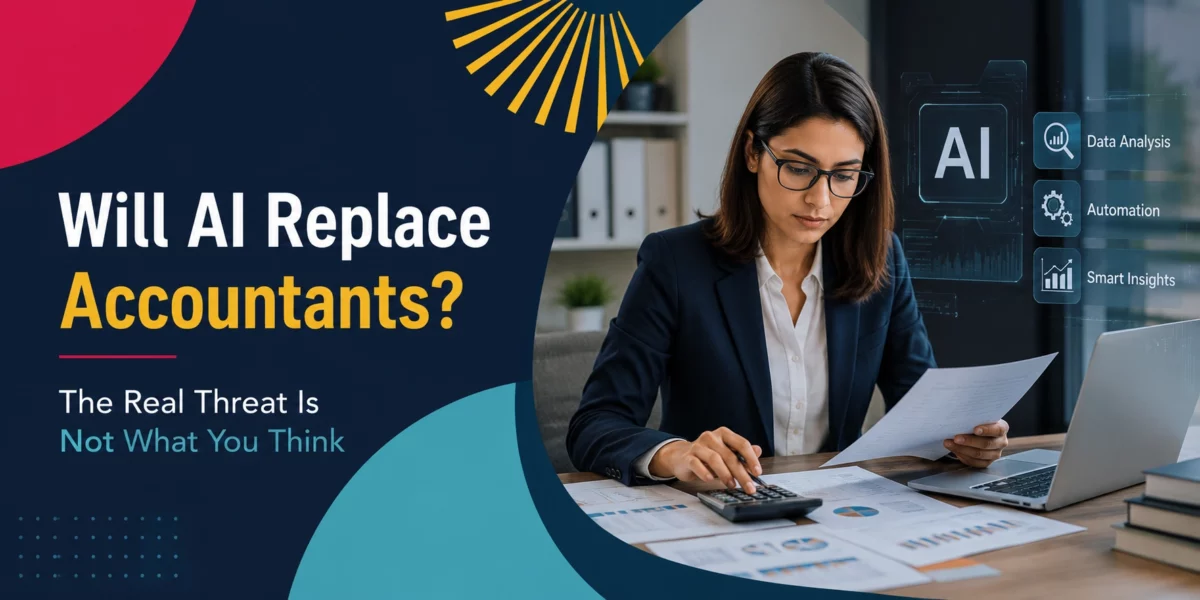
As an Accountant, What Happens If I Don’t Adapt to AI?
For decades, accounting professionals have been trusted advisors to businesses, organizations, and individuals.
They manage financial records, prepare reports, ensure compliance, support decision-making, and help organizations achieve financial success.
However, the accounting profession is changing.
Artificial Intelligence (AI), automation, cloud accounting systems, business analytics, and digital technologies are transforming how accounting work is performed.
The question many accounting professionals should be asking is:
What Happens If I Don’t Adapt?
The answer may determine the future of your career.
AI Is Not Replacing Accountants
Let’s start with some good news.
AI is not replacing accountants.
Businesses will continue to need professionals who understand:
• Accounting principles
• Financial reporting
• Payroll administration
• Taxation
• Compliance requirements
• Financial controls
• Business operations
However, AI is changing how these tasks are performed.
The accountants who embrace technology will often become more productive, more valuable, and more competitive.
The accountants who resist change may find themselves falling behind.
The Work Is Changing
Traditionally, accountants spent considerable time on:
• Data entry
• Bank reconciliations
• Invoice processing
• Expense categorization
• Report preparation
• Payroll calculations
Today, many of these tasks can be partially automated using:
• AI-powered accounting software
• Cloud accounting platforms
• Intelligent reporting systems
• Business analytics tools
• Automated payroll solutions
This means accountants are spending less time entering data and more time:
• Analyzing financial information
• Supporting business decisions
• Identifying trends and risks
• Advising management
• Improving business performance
Employers Are Looking for More Than Accounting Knowledge
Modern employers increasingly seek accounting professionals who understand:
• QuickBooks and cloud accounting systems
• Business analytics and reporting tools
• Advanced Excel and data analysis
• AI productivity tools such as Microsoft Copilot
• Financial dashboards and business intelligence
• Digital document management
• Data security and privacy requirements
The modern accounting professional is becoming a technology-enabled business professional.
What Could Happen If You Don’t Adapt?
Reduced Career Opportunities
Employers increasingly prefer candidates who can work efficiently with modern accounting technologies.
Two candidates may have similar accounting knowledge, but the one who understands AI tools, cloud accounting platforms, and analytics will often have a competitive advantage.
Lower Productivity
Professionals who continue relying exclusively on manual processes may spend significantly more time completing tasks that can be partially automated.
Limited Career Growth
As organizations adopt digital transformation initiatives, leadership opportunities increasingly go to professionals who understand both business operations and technology.
Increased Competition
The next generation of accounting professionals is entering the workforce with exposure to AI, automation, analytics, and cloud-based business systems.
Keeping your skills current is becoming increasingly important.
What Skills Should Accountants Develop?
You do not need to become a programmer.
You do not need to become a data scientist.
However, developing skills in the following areas can help strengthen your future career prospects:
Artificial Intelligence for Business Professionals
Learn how AI can support productivity, reporting, communication, and administrative tasks.
Cloud Accounting Systems
Gain experience with modern accounting platforms and digital workflows.
Business Analytics
Learn how to transform financial data into meaningful business insights.
Microsoft Excel and Power BI
Develop stronger reporting and data visualization skills.
Payroll Technology
Understand modern payroll systems, compliance requirements, and automation tools.
Cybersecurity Awareness
Financial information is among the most valuable data within an organization.
Understanding security and privacy fundamentals is increasingly important.
The Future Accountant Will Be a Strategic Advisor
The accounting profession is evolving from transaction processing to business intelligence and decision support.
Tomorrow’s accounting professionals will increasingly help organizations:
• Interpret data
• Improve profitability
• Manage risks
• Support strategic planning
• Leverage technology effectively
Technology is not eliminating the need for accountants.
It is creating opportunities for accountants who are willing to evolve.
How Canadian College for Higher Studies Can Help
Canadian College for Higher Studies (CCHS) offers training designed to help accounting and administrative professionals prepare for today’s technology-driven workplace.
Computerized Accounting & Office Administration Diplomas
Preparing accounting and office professionals for the digital workplace.
Students develop practical skills in:
• Accounting and bookkeeping
• Payroll administration
• QuickBooks and cloud accounting systems
• Advanced Excel and reporting
• Business analytics
• AI productivity tools
• Data management and digital workflows
One-Day Workshops and Micro-Skills Training
Professionals can also upgrade their skills through focused training in:
• AI for Accounting and Payroll Professionals
• Microsoft Copilot for Office Productivity
• Business Analytics and Reporting
• Data Analytics Fundamentals
• AI Productivity and Automation
The Choice Is Yours
The accounting profession is not disappearing.
It is evolving.
Those who embrace AI, analytics, automation, and digital business tools will likely discover new opportunities, greater productivity, and stronger career prospects.
Those who ignore these changes may find it increasingly difficult to compete in a modern workplace.
The question is not whether AI will affect accounting.
The question is whether you will be ready when it does.
Contact Canadian College for Higher Studies to learn about diploma programs, workshops, micro-skills training, and workforce development opportunities that can help you prepare for the future of accounting.
Frequently Asked Questions
No, AI is not expected to replace accountants. Instead, it is changing how accounting work is performed, allowing professionals to focus more on financial analysis, advisory services, and strategic decision-making.
AI-powered software and automation tools help accountants improve productivity, reduce manual work, and deliver more valuable insights to businesses and clients.
Today’s accountants benefit from knowledge of cloud accounting platforms, QuickBooks, business analytics, Power BI, Microsoft Excel, AI productivity tools, and automated payroll systems.
Professionals who avoid new technologies may face increased competition and fewer career opportunities. Employers increasingly value accountants who combine accounting expertise with digital skills.
Skills in business analytics, cloud accounting systems, data visualization, payroll technology, cybersecurity awareness, and AI productivity tools can strengthen long-term career prospects.
The profession is evolving from transaction processing to strategic business support. Modern accountants are increasingly helping organizations improve profitability, manage risks, and make data-driven decisions.
Also Read
- What Is Agentic AI? Skills, Careers & Future Job Opportunities
- Best Courses to Get a Job in Canada After Graduation
- AI, IoT and Edge Computing: How These Technologies Work Together
- AI-Powered Cyber Attacks: What Students & Businesses Must Know
- What Is Healthcare Administration and Is It Good in Canada?