

Difference Between College and University in Canada: Complete 2026 Guide
Let me be honest with you right away. Most students pick one without actually knowing the difference. They go with whatever their older sibling did, or whatever their high school counsellor suggested in a 15-minute meeting. And then two years in, they realize the program they enrolled in does not take them where they wanted to go.
Whether you are fresh out of high school, moving to Canada as an international student, or starting over in your career, understanding what separates a college from a university is one of the most practical things you can do before spending tens of thousands of dollars on education.
So let’s actually talk through it.
Are college and University the Same Thing?
Short answer: No, and in Canada the difference is especially clear.
People mix up these two words all the time, particularly those coming from the United States where “college” often just means any post-secondary school. In Canada, that casual usage causes real confusion because colleges and universities are legally separate types of institutions. They are governed differently, they grant different credentials, and they train students for different kinds of futures.
A college diploma and a university degree are not interchangeable. Knowing which one your career actually needs is the whole point of this guide.
College vs University: The Core Difference at a Glance
| Feature | College | University |
| Program Length | 1 to 3 years (applied degrees: 4 years) | 3 to 5 years |
| Credential | Certificate, Diploma, Applied Degree | Bachelor’s, Master’s, PhD |
| Focus | Practical and career-ready | Academic and research-based |
| Class Size | Smaller (20 to 35 students typically) | Often large lecture halls |
| Annual Tuition (International) | CAD 10,000 to 20,000 | CAD 25,000 to 45,000 |
| Admission Requirements | Generally flexible | More competitive |
| Application Portal (Ontario) | OCAS (ontariocolleges.ca) | OUAC (ouac.on.ca) |
| Teaching Style | Instructors with industry backgrounds | Professors focused on research |
| Research Opportunities | Limited | Extensive |
What Is the Difference Between College and University in Canada?
Think of it this way. College prepares you for a job. University prepares you in a subject. Whether you are looking at the difference between university and college or trying to figure out university vs college for your specific situation, the answer always comes back to what you actually want to do after graduation. Both are legitimate paths, but they serve very different purposes.
Canadian colleges operate under different names depending on the province. You will hear community college, polytechnic, career college, and institute of technology. All of them fall under the same umbrella: applied, career-focused education. In Ontario, there are 24 publicly funded colleges. Programs they offer include:
- Ontario College Certificate: 1 year
- Ontario College Diploma: 2 years
- Ontario College Advanced Diploma: 3 years
- Postgraduate Certificate: 1 year (for people who already hold a degree or diploma)
- Applied Bachelor Degree: 4 years, available at schools like Seneca Polytechnic, Humber Polytechnic, and George Brown College
Universities sit on the other side. They grant academic degrees at every level from bachelor’s to PhD, and they are the only institutions in Canada legally allowed to confer professional credentials in fields like medicine, pharmacy, dentistry, and law.
Here is something worth flagging that most people do not know: some Canadian colleges now offer full four-year applied bachelor degrees. These are not university degrees but they carry real employer recognition and some even hold professional accreditation. The line between college and university has blurred more than the traditional narrative suggests.
When Should You Choose a University?

University makes clear sense in some situations. Here is when it genuinely is the right call.
You need a licensed profession. Medicine, pharmacy, dentistry, law, and licensed engineering. These fields are regulated by professional bodies in Canada that require degree-level credentials by statute. There is no way around it.
You want to work in research or teach at the post-secondary level. Academic careers require graduate degrees. A master’s at minimum, usually a PhD for tenure-track positions. If that is the direction you are heading, university from day one makes sense.
Your field has a hard degree ceiling. Psychology, social work, and education administration. You might be able to get a foot in the door with a diploma, but the roles above entry level almost always require a full degree. Worth mapping out before you start.
You want access to global research networks. Schools like the University of Toronto, UBC, McGill, and McMaster have international partnerships and alumni networks that open specific kinds of doors. In consulting, investment banking, and research-heavy industries, where you went to school still carries weight.
Long-term earnings are your benchmark. According to Statistics Canada’s National Graduate Survey, university degree holders in management, legal, and medical careers consistently earn more at the median across their full career. The gap narrows in technology and skilled trades, but in corporate environments, it is real and sustained over time.
When Should You Choose College?
College is far more valuable than its reputation suggests. In a lot of situations, it is actually the sharper choice.
You want income sooner. A two-year diploma gets you into the workforce two or three years ahead of a university peer. In fields like IT support, business analytics, and medical office administration, starting earlier compounds over time in ways that are hard to overstate.
Your field rewards practical skills. Employers in network administration, graphic design, early childhood education, supply chain, and culinary arts are specifically looking for people who can do the work right away. A general university degree rarely provides that. College programs are built around it.
Tuition is a real constraint. International students at Canadian colleges typically pay CAD 10,000 to 20,000 per year. At universities, that range jumps to CAD 25,000 to 45,000. Over a three-year program, factoring in living costs, the total difference can reach CAD 50,000 or more.
Your life does not fit a traditional full-time schedule. College programs commonly run in the evenings, on weekends, and in hybrid formats. A lot of college students are working part-time, raising kids, or supporting their families. The system is built with that reality in mind.
College vs University: Province by Province
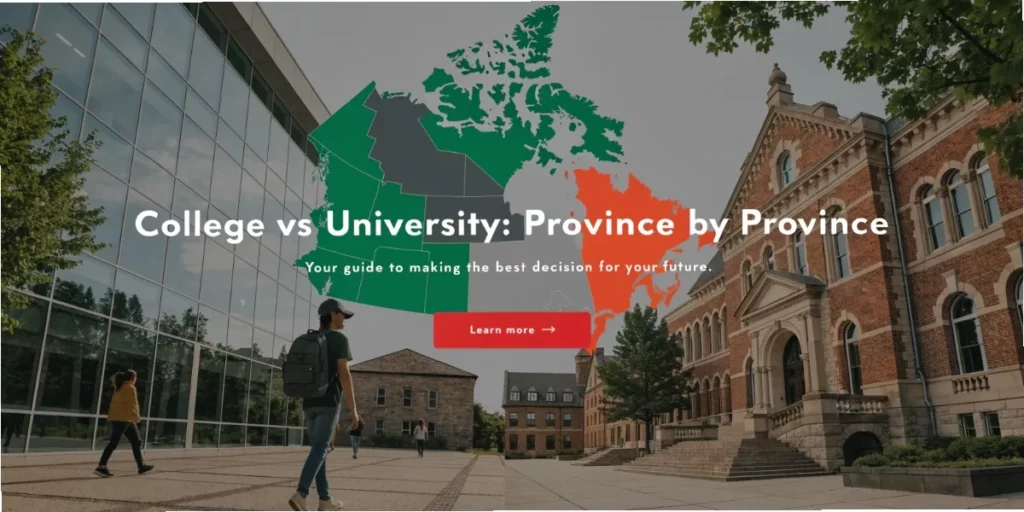
One thing that catches students off guard is that the rules differ by province. Here is a quick breakdown.
Ontario
Ontario has the sharpest separation between college and university in the country. Colleges apply through OCAS and universities through OUAC. Ontario’s college system is known for its postgraduate certificate programs, which is a major draw for international students who already hold a credential from their home country.
If you are looking at diploma programs in Ontario, The Canadian College offers career-focused programs designed to get you working in your field without the four-year timeline.
British Columbia
BC runs a more flexible system. Institutions like Kwantlen Polytechnic University and Thompson Rivers University sit in a hybrid category, offering both diplomas and degrees under one roof. Students in BC have more crossover options than in most other provinces.
Quebec
Quebec is completely different from everywhere else in Canada, and this trips up a lot of students. Before you can go to university in Quebec, you must first complete a two-year program at a CEGEP (Collège d’enseignement général et professionnel). This is not optional. It is a mandatory step built into the provincial education structure. If you are relocating to Quebec or applying from outside the province, plan this into your timeline from the start.
Alberta
Alberta has a strong polytechnic culture. NAIT (Northern Alberta Institute of Technology) and SAIT (Southern Alberta Institute of Technology) offer technical diplomas, applied degrees, and some bachelor-level programs. For trades-focused students, especially, Alberta’s college infrastructure is among the best in the country.
Admission Requirements: What Each Actually Needs
Getting Into College in Ontario
- Ontario Secondary School Diploma or a comparable international credential
- Program-specific course requirements vary by field
- English language proficiency: IELTS 6.0 overall (some programs accept 5.5 with no band below 5.0)
- No entrance exam required in most cases
- Applications through OCAS at ontariocolleges.ca
- Rolling admissions mean you can often get a decision within a few weeks
Getting Into University in Ontario
- OSSD with six Grade 12 university-level or university/college preparation courses
- Competitive average typically ranging from 70 to 85 percent depending on program
- English language proficiency: IELTS 6.5 overall, often with no individual band score below 6.0
- Certain programs require supplementary applications, portfolios, or auditions
- Applications through OUAC at ouac.on.ca
- Offers typically come in batches between February and May
For international students, college admissions are generally faster. Most colleges have three intake periods per year: September, January, and May.
What Do Graduates Actually Earn? Real Numbers
Based on data from Statistics Canada’s Labour Force Survey and National Graduate Survey, here is how median earnings compare across credential types in Canada:
| Credential | Median Annual Earnings | Source |
| No post-secondary | CAD 35,000 to 40,000 | Statistics Canada LFS |
| College Certificate or Diploma | CAD 52,000 to 65,000 | Statistics Canada NGS |
| Trades Certificate (Red Seal) | CAD 60,000 to 90,000+ | Statistics Canada LFS |
| Bachelor’s Degree | CAD 65,000 to 85,000 | Statistics Canada NGS |
| Master’s Degree | CAD 80,000 to 100,000 | Statistics Canada NGS |
| PhD or Professional Degree | CAD 95,000 to 130,000+ | Statistics Canada NGS |
The Trades Path: Seriously Underrated
This one gets overlooked in almost every college vs university comparison, and it should not.
Canadian colleges offer pre-trades programs and registered apprenticeships across a wide range of skilled fields:
- Electrical work
- Plumbing
- HVAC (heating, ventilation, and air conditioning)
- Welding
- Automotive service technology
- Carpentry
Complete your apprenticeship, pass the Red Seal exam, and you earn the Interprovincial Standards Certificate. It is recognized in every province. It cannot be outsourced. And the demand for licensed tradespeople in Canada is not going down anytime soon. For students who want job security, physical work, and strong earnings without four years of academic study, trades at college is one of the most financially solid decisions available in this country.
Can You Go from College to University Later?
Yes, and more people should think about this as an option.
Many Canadian universities have formal credit transfer agreements with colleges. This means finishing a two-year diploma can earn you direct entry into second or third year of a related bachelor’s program. A few established pathways:
- Seneca Polytechnic to York University: Business, IT, and liberal arts transfer routes
- Humber Polytechnic to University of Guelph-Humber: Joint programs where you graduate with both a diploma and a degree
- George Brown College to Toronto Metropolitan University: Pathways in business, early childhood education, and culinary arts
Starting at college, building real skills, and then transferring to university is a legitimate strategy. You often perform better academically because you already understand how the subject applies in practice.
Part-Time and Online Study
Not everyone can sit in a classroom five days a week. This is where college tends to win on practical grounds.
Evening classes, weekend delivery, and hybrid formats are standard at most Canadian colleges. Many postgraduate certificate programs run entirely in the evenings and are built specifically for working adults. Schools like Seneca, Humber, and George Brown have large continuing education divisions for exactly this reason.
Universities are catching up on online delivery, especially at the graduate level. Athabasca University runs entirely online. Most major universities now offer some online undergraduate courses. But first and second year on-campus expectations at traditional universities remain fairly strong.
If your personal situation requires flexibility, college programs generally offer more of it at the undergraduate level.
Do Canadian College Credentials Work Outside Canada?
For most purposes, yes. Canadian College for higher studies diplomas are recognized and respected in the UK, Australia, Ireland, the US, and most of Western Europe. If you need a formal evaluation for an employer or immigration authority abroad, World Education Services (WES) provides accredited credential assessments.
For regulated professions such as nursing, engineering, and accounting, bridging exams or additional licensing may be required depending on where you plan to work. The Canadian Information Centre for International Credentials (CICIC) at cicic.ca has a country-by-country directory for this.
What Is Student Life Actually Like?
At University
Big campuses. Hundreds of clubs, varsity sports, student government, campus pubs, and the kind of social infrastructure that takes on a life of its own. Schools like U of T, UBC, and McGill feel like small cities. If you thrive in that kind of environment and want four years of full academic immersion, university delivers it.
At College
Smaller campuses, tighter cohorts, and a peer group that often includes people in their late 20s, 30s, and beyond. The atmosphere is more professionally oriented. Your instructors are usually people who spent years working in the actual field before they started teaching it, and that makes a real difference in the classroom.
Housing and Services
Both institution types offer on-campus housing, but spots fill up fast in Toronto and Vancouver. Most students live off campus regardless. Academic counselling, mental health support, and health services are available at both. At colleges, students often find it easier to actually access these services because the institution is smaller and less bureaucratic.
Final Thoughts
No version of this answer fits everyone.
University is the right call when your career demands it. Medicine, law, research, graduate academia. The long-term earning ceiling in professional fields is genuinely higher with a degree, and the institutional networks at schools like UBC, McGill, and U of T open real doors in specific industries.
College makes just as much sense when your career is skills-based, your budget is real, or your timeline matters. The Red Seal trades. IT and cybersecurity. Healthcare support. Business administration.
The students who end up frustrated are usually the ones who picked based on what sounded right rather than what was actually right for them. Spend an hour genuinely thinking about where you want to be in five years. Then work backwards from there. College or university becomes a much easier decision once you start from the outcome and not the prestige.
FAQs: Difference Between College and University
Colleges offer hands-on, career-focused programs that lead to certificates, diplomas, and applied degrees. Universities offer academically-oriented programs leading to bachelor’s, master’s, and doctoral degrees. In Canada, they operate under separate provincial legislation and grant fundamentally different credentials.
College gets you job-ready faster and at lower cost. University takes longer and goes deeper into theory and research. College instructors typically have industry experience. University professors are primarily researchers. Neither is objectively better. It comes down to what your career actually requires.
No. They are governed by different legislation, grant different credentials, and serve different educational purposes. Some provinces like BC have institutions that blend both models, but the credentials issued remain distinct. Using the two terms interchangeably in Canada can create real confusion during the application process.
Yes. Many universities have articulation agreements with colleges that allow diploma graduates to enter degree programs at the second or third year level. Seneca to York, Humber to Guelph-Humber, and George Brown to Toronto Metropolitan University are well-known examples.
College typically requires an OSSD or equivalent and an IELTS score around 6.0. University is more selective, generally requiring an average of 70 to 85 percent and IELTS 6.5 with strong individual band scores. College applications through OCAS are usually faster to process and have more intake windows throughout the year.
In Quebec, students must complete a two-year CEGEP program before entering university. This step is mandatory and built into the provincial education structure. It is not the same as the voluntary college-to-university transfer pathways available in Ontario or BC. Anyone planning to study in Quebec needs to factor this into their timeline from the beginning.